- Morning stiffness is mostly plumbing. Your spinal discs soak up fluid overnight, the pressure inside them more than doubles while you sleep [1], and you wake about 2 cm taller than you went to bed [2][3]. A full disc bends less willingly.
- The first hour matters. Bending the lumbar spine forward in the early morning loads the discs with roughly three times the bending stress of the same movement later in the day [4], and reach is lower first thing than in the evening [5][6]. Movement first, depth never.
- Stiffness that eases within minutes of moving is normal. Stiffness lasting more than 30 minutes, waking you in the second half of the night and improving with exercise but not rest is inflammatory back pain until a GP says otherwise [7][8][9].
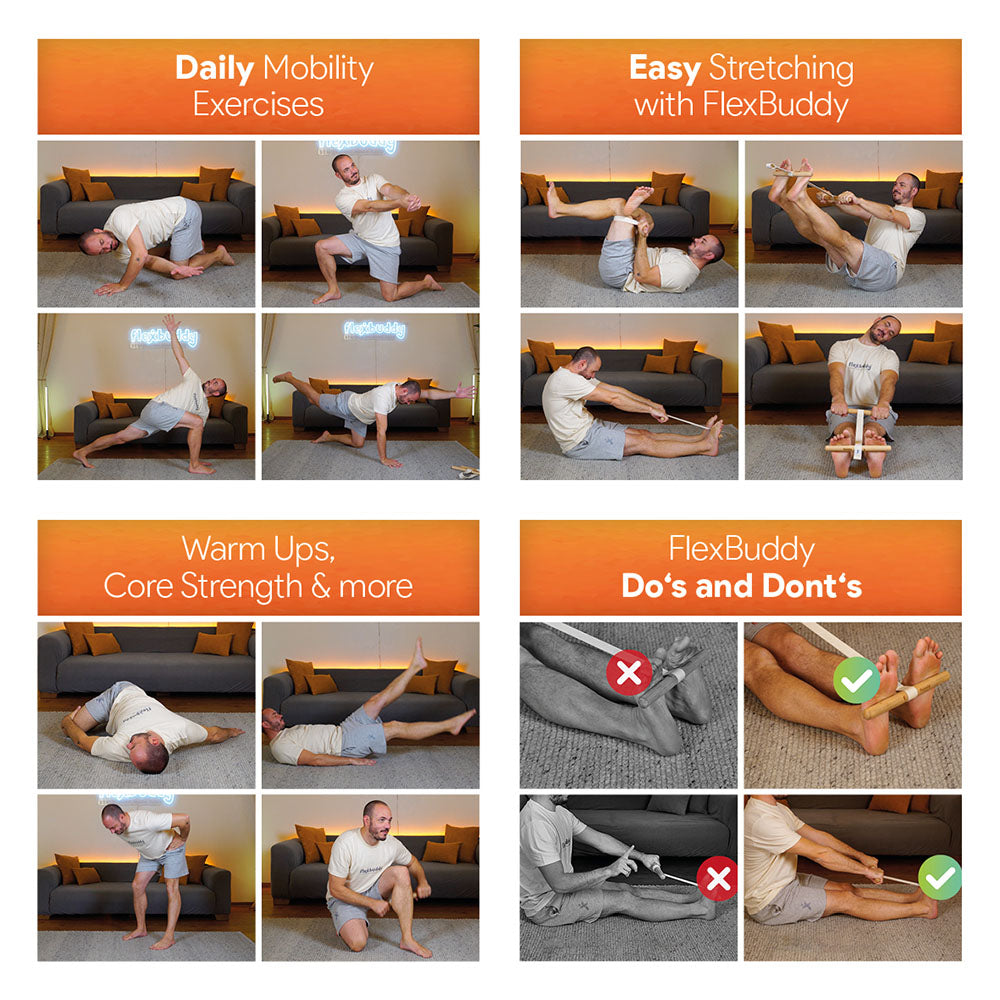
- The routine: five FlexBuddy Stretching Guide exercises in wake-up order (Hamstrings Warm Up, Alternating Stretch, Basic Posture, Dynamic Rolling, Relax The Neck), five minutes, the first two sitting up in bed. Guideline dose: about 60 seconds per muscle group, at least two to three days a week, never into pain [10][11].
Mornings are when stiffness does its best work: you've spent seven hours in roughly one position, and your back, hips and legs greet the day like rusted hinges. The fix doesn't require becoming a 5 a.m. person. It requires five gentle exercises that take less time than your coffee brews, done in the right order, with one rule about the first hour that most morning routines ignore.
Why do you wake up stiff?
Overnight, you barely move, and tissues that don't move for hours simply feel stiff when asked to work again. The bigger reason is measurable, and it lives in your spine.
Your discs fill up at night
The discs between your vertebrae behave like sponges: loaded by standing and sitting they slowly lose fluid, and lying flat at night they draw it back in. A pressure sensor implanted in a volunteer's L4–L5 disc recorded the pressure rising from 0.1 to 0.24 MPa over seven hours of sleep; the same study concluded that changing position is what keeps fluid, and so nutrition, moving through the disc [1]. In eight young men measured around the clock, stature varied by 19.3 mm, peaking at 07:30 on waking, and over half of that height was lost again in the first hour after rising [2][3].
Why the first hour is different
A full disc is a stiffer disc. Researchers measured the lumbar flexion of 21 volunteers in the early morning and the afternoon and found it increased by 5 degrees over the day; creep-loading cadaver spines to simulate a day's activity reduced their resistance to bending, particularly in the disc [4]. Combining the two, they calculated that forward bending puts about 300% more bending stress on the lumbar discs in the early morning than later in the day, and about 80% more on the ligaments [4].
That is the first-hour bending rule, and the design rule for this routine: movement first, depth never. Rhythmic, easy ranges wake tissues up; ambitious holds on a cold, full spine just trigger guarding, and the one position to avoid in the first hour is a deep forward fold with a rounded lower back. Every exercise below respects that rule, and the FlexBuddy handles enforce it kindly, since depth always stays in your grip.
When morning stiffness is a warning sign
Normal morning stiffness eases within minutes of moving and is gone by breakfast. Stiffness that behaves differently can be the first sign of an inflammatory condition such as ankylosing spondylitis, which is treatable and often diagnosed years late.
Rheumatologists tell inflammatory from mechanical back pain by the history. In 213 people under 50 with chronic back pain, the features that pointed to the inflammatory kind were morning stiffness lasting more than 30 minutes, no improvement with rest, waking because of back pain in the second half of the night only, and alternating buttock pain; two of the four gave a sensitivity of 70% and a specificity of 81% [7]. The international expert criteria add insidious onset and onset before 40 [8]. The NHS puts it plainly: in ankylosing spondylitis the pain and stiffness are worse in the morning and at night, better with exercise, not improved or worse with rest, and it usually starts between 18 and 40 [9]. If that sounds like your mornings, see your GP before treating it as a stretching problem.
The red flags for any back pain: get urgent help for pain, tingling, weakness or numbness in both legs, loss of feeling around the genitals or anus, changes in bladder or bowel control, chest pain, or pain after a serious accident; see a GP soon if you feel hot, shivery or unwell, if the pain is sudden and severe or worsening quickly, if you have lost weight without trying, or if it is worse at night [12]. For everything else, the NHS says stay active and try stretches [12].
The morning stretching routine: five exercises in wake-up order
Five exercises from the FlexBuddy Stretching Guide, in the order that respects the first-hour rule. The first two work sitting up in bed; the last three are better on the floor. The holds sit inside the 10-to-30-second range where most of the change in range happens [13].
| Exercise | Targets | Time | Where | Wake-up role |
|---|---|---|---|---|
| Hamstrings Warm Up | Hamstrings, lower back | 45 s | In bed or on the floor | First movement of the day |
| Alternating Stretch | Legs, sides of torso | 45–60 s | In bed or on the floor | Spreading the warmth |
| Basic Posture | Whole back | 30–45 s | Floor | Undoing the mattress shape |
| Dynamic Rolling | Spine, segment by segment | 30–45 s | Floor | Oiling the hinges |
| Relax The Neck | Neck, upper traps | 15–20 s per side | Floor or edge of bed | Releasing pillow tension |
Before you start: the in-bed minute
Lie on your back, draw one knee then the other towards your chest, and let the lower back settle. Then roll onto your side and push up to sitting with your hands rather than sitting straight up, which is exactly the loaded forward bend the morning spine dislikes [4].
1. Hamstrings Warm Up: the gentlest possible start (45 seconds)
- Sit up in bed or on the floor, legs extended, FlexBuddy hooked around the soles of your feet.
- Hold the handles loosely, sit as tall as the morning allows.
- Rock gently forward and back in a tiny range, smaller than you think, for about 45 seconds.
What you should feel: a soft, moving pull behind the thighs that warms as you go. Morning version: even milder than usual. Why it's first: rhythmic motion is the politest way to tell a sleepy nervous system the day has started.
2. Alternating Stretch (45 to 60 seconds)
- Open the legs comfortably apart, hook FlexBuddy around one foot.
- Hinge gently toward that leg for a breath or two with a long back, rise, switch the tool to the other foot.
- Keep a slow, flowing left-right rhythm for 45 to 60 seconds.
What you should feel: the stretch travelling, each thigh in turn, the sides of the torso opening as you alternate. Why it works in the morning: alternating movement spreads warmth through both legs and the waist without parking anywhere long enough for a cold muscle to object. Now move to the floor.
3. Basic Posture (30 to 45 seconds)
- Knees bent, tool hooked around both feet, arms long on the handles.
- Lean back slightly into the support, lift your chest, let the spine lengthen.
- Breathe for 30 to 45 seconds (about ten slow breaths), shoulders soft.
What you should feel: the night's curled shape gently reversing; decompression, not effort. Why mornings love it: it resets "tall" as the day's default before the desk gets a vote.
4. Dynamic Rolling (30 to 45 seconds)
- From Basic Posture, keep light tension on the handles.
- Exhale and slowly round backward, rolling down vertebra by vertebra; inhale and roll back up.
- Three to five unhurried cycles, one full breath per cycle, minimum.
What you should feel: segment-by-segment articulation; the spine going from "plank of wood" to "chain of links". You roll backward against the strap, never forward over the legs. Common mistake: morning haste. If you're rushing this one, skip it and keep the others slow instead.
5. Relax The Neck (15 to 20 seconds per side)
- Anchor the tool under your feet, hold one handle to gently weigh down that shoulder.
- Tilt your head slowly to the opposite side until a soft stretch appears.
- 15 to 20 seconds per side, slow breath.
What you should feel: whatever the pillow did last night, easing. Why it's the closer: you stand up feeling lighter exactly where mornings feel heaviest.
Then stand up
Stand tall, reach both arms overhead for two slow breaths, lean a little to each side, and walk to the kettle; changing position is what the discs want next [1]. Two rules for all five: mild tightness, never pain, and breathe through every hold. How to use FlexBuddy covers the strap adjustment; if your day continues at a desk, the natural sequel is the sitting-all-day routine.
The 5-minute and 10-minute versions
5-minute morning stretching routine
Exactly the table above, plus the in-bed minute and the standing finish: roughly the guideline dose of 60 seconds for the hamstrings and the back [10][11]. Rushed morning? One exercise still counts.
10-minute morning stretching routine
Do not add depth; add repetitions and a second muscle group. Run the first two exercises for a minute each. Hold Basic Posture for ten breaths, pause, and repeat twice more; no further elongation occurs after two to four repetitions [13]. Add the Butterfly for the hips, 30 seconds, and the Shoulder Opener, 20 seconds per side, from the FlexBuddy exercise library; then Dynamic Rolling, the neck, and stand.
Morning stretching routine for beginners
You will reach less far than in the evening; that is the body clock, not failure [5][6]. Two adjustments.
- Set the strap to today's flexibility, not the one you would like. If your lower back rounds, move the foot bar to a longer loop.
- Halve the holds for the first week. Twenty seconds of Basic Posture is plenty: in a six-week trial of adults with tight hamstrings, a single 30-second stretch a day gained as much range as 60-second holds or three sessions a day [14] (more in how long to hold a stretch). Judge the session by the feeling after it, not the depth during it.
If the floor is the obstacle, our guide to stretches in bed builds a routine that never touches it.
Morning stretching routine for over 50
A national survey of hip and knee range concluded that, at least to age 74, any substantial loss of joint mobility should be viewed as abnormal rather than a normal part of ageing [15]. The loss came from not using the range; using it brings it back. One owner, Bob J., 64, had never touched his toes and did so after a week; a blacksmith of 73 said he never imagined regaining his flexibility and did. With osteoporosis, a hip replacement or recent spinal surgery, read stretching for seniors first.
Hold a little longer. In a trial of 62 people aged 65 to 97 with tight hamstrings, stretching five days a week for six weeks, 60-second holds gained range at 2.4 degrees a week against 1.3 for 30 seconds and 0.6 for 15, and the gains lasted longer [16]; older adults may need longer than the usual 15 to 30 seconds [13]. After the first fortnight, take Basic Posture towards a minute, in two or three holds.
Get up slowly. Blood pressure can dip when you change position quickly; the NHS advice for anyone who feels dizzy on standing is to move slowly from lying to sitting to standing [17]. The in-bed minute is built for this; do the standing finish with a hand on the bed frame at first, and let the strap keep the spine long instead of reaching for feet you cannot see before breakfast.
Morning stretching routine for men, and for women
Search engines are asked for both, so here is the honest answer: the muscles are the same, the routine is the same, and the morning spine does not care which box you tick. What differs is the pattern people arrive with.
For men
The common pattern is strong and short: hamstrings and hips tightened by cycling, running, lifting or a desk, and a forward bend that happens at the lumbar spine because the pelvis will not tip. The goal is usually a back that stops complaining and a squat that stops rounding. Same routine, with the Hamstrings Warm Up and Alternating Stretch done with a long back and a longer strap than pride suggests. Test your toe touch in the evening, when the spine is at its most flexible [4][5].
For women
The common pattern is more range in the hamstrings and hips and more tension in the neck, upper back and shoulders: give Basic Posture and Relax The Neck their full time and add the Shoulder Opener in the 10-minute version. If you are pregnant or recently postnatal, joint laxity changes, so keep every hold mild and check the routine with your midwife or physiotherapist; if your bone density is low, avoid loaded forward bends and read the seniors guide first. None of this is gendered pseudoscience; it is the same five exercises with the time allocated to where you are tight.
Morning or evening: when is stretching better?
For range, the evening has the edge. Lumbar flexion is about 5 degrees greater in the afternoon than the early morning and the bending stresses on the discs are far lower [4]. Flexibility has a body clock: in 25 adults measured every two hours for a day, every flexibility test showed a circadian rhythm, strongest for fingertip-to-floor reach [5]; in 26 young men, sit-and-reach scores were higher at 18:00 than at 08:00 [6]; and in footballers core temperature was a degree lower at 08:00 than at 16:00, with sit-and-reach rising alongside it [18]. Deep holds belong in the evening.
For consistency, whichever happens. Harvard's summary of the ACSM guidance treats first thing in the morning, after a workout or unwinding in the evening as equally valid [11]. A 2018 review of 23 long-term studies found that weekly time (from about five minutes) and weekly frequency were linked to range, while time within a single session was not [19].
For the habit, the morning wins on reliability. In the best-known study of real-world habit formation, automaticity plateaued after an average of 66 days of repeating an action in the same context, and the advice is to choose a time and place you encounter every day of the week [20]. The morning is the one slot nothing else has claimed yet.
The honest verdict: a short, movement-first routine in the morning for how the day feels; deeper holds in the evening if range is the goal; if you only have one slot, pick the one you will still be using in March. Sara F., an Amazon reviewer, does both: "I use it before I go to bed and if I don't, I can really tell a difference in the morning."
Making it a real morning habit
Put FlexBuddy where your feet land, literally next to the bed or by the kettle. Attach the routine to something that already happens: coffee brewing is the classic anchor, since five minutes is almost exactly one pot, and routine-based cues are what the habit researchers recommend [20]. Honour the bad-morning rule: one exercise still counts, and missing the occasional day did not seriously impair habit formation [20]. The streak is the asset, not the session length. On the worst mornings, the two-minute version keeps the chain alive.
An honest timeline
Day one: the morning feels different. You stand up looser than you sat down. That is real and temporary: the extra length a single stretch produces is transient [21].
Weeks two to six: the stiffness shrinks. Programmes of three to eight weeks produce measurable range, explained by a change in how much stretch you tolerate rather than longer muscle [21]; six weeks was enough in both the younger [14] and the older [16] hamstring trials. Expect centimetres, not transformations, measured in the evening [5].
Around two months: it stops being a decision. The habit study's average was 66 days [20]. One three-star Amazon review put it honestly: the device "does exactly what it should", but at eight weeks he was still short of his toes, with progress. Progress is the point.
Doing this with FlexBuddy
The whole routine comes down to one position done half-awake: a long spine folding at the hips while the legs stay straight, with the depth under your control. FlexBuddy® is a patented stretching device made of two beech-wood bars joined by an adjustable natural-cotton strap. One bar goes under the soles of your feet, the other in your hands; you sit tall, lean back and tilt the hips, and the strap carries the pull so your lumbar spine never has to round to reach, which is exactly what the morning discs need. The foot bar moves between loops for big changes and the hand bar rolls the strap for small ones, so the first week starts long and shortens a notch at a time. The wooden handles do not cut into sleepy hands the way a towel does, and at about 32 cm it lives on the bedside floor. Lifetime warranty, 30-day money-back guarantee. See FlexBuddy, or take the two-minute quiz to find the routine for your kind of stiffness.
Frequently asked questions
What is a good morning stretching routine for beginners?
Five gentle exercises in wake-up order, about five minutes: Hamstrings Warm Up and Alternating Stretch sitting up in bed, then Basic Posture, Dynamic Rolling and Relax The Neck on the floor. Holds of 20 to 30 seconds [13], mild tightness only, no deep forward bends in the first hour after waking [4].
What is the best morning stretching routine for over 50?
The same five exercises, slower: move from lying to sitting to standing in stages [17], and after the first fortnight take the seated holds towards 60 seconds, which gave faster, longer-lasting gains in a trial of adults over 65 [16].
Can I do a morning stretching routine in bed?
The first two exercises, yes: sit up with your legs straight, hook the strap under your feet, and do the Hamstrings Warm Up and the Alternating Stretch on the mattress. The posture and rolling exercises want a firm floor.
How long should a morning stretching routine be?
Five minutes covers all five exercises at about the guideline dose of 60 seconds per muscle group [10][11]; ten minutes adds hips and shoulders. Longer holds buy little: 30 seconds once a day matched 60 seconds in a six-week trial [14].
Is it good to stretch in the morning?
Yes, if it is gentle. Movement after waking eases the normal stiffness and starts the fluid exchange the discs need [1]. Avoid a deep, rounded forward bend in the first hour, when the bending stress on the full discs is about three times higher than later in the day [4].
Should I stretch in the morning or at night?
Evening is when you are most flexible and deep holds are safest [4][5][6]; morning is the slot most people keep, and Harvard's guidance treats either as fine [11]. Range: evening. Feeling good all day: a gentle morning. Ideally both.
This article is general information, not medical advice. Tight muscles usually respond well to regular stretching. If your pain is sharp, radiates down a leg, comes with numbness, weakness, fever, bladder or bowel changes, follows an injury, or keeps getting worse, see a doctor or physiotherapist before you stretch. Morning stiffness that lasts more than 30 minutes, wakes you at night and eases with exercise but not rest should be assessed by a GP.
References
- Wilke HJ, Neef P, Caimi M, Hoogland T, Claes LE. New in vivo measurements of pressures in the intervertebral disc in daily life. Spine. 1999;24(8):755–762. doi:10.1097/00007632-199904150-00005. PMID 10222525 (abstract accessed 4 Nov 2026).
- Reilly T, Tyrrell A, Troup JD. Circadian variation in human stature. Chronobiol Int. 1984;1(2):121–126. doi:10.3109/07420528409059129. PMID 6600017 (abstract accessed 4 Nov 2026).
- Tyrrell AR, Reilly T, Troup JD. Circadian variation in stature and the effects of spinal loading. Spine. 1985;10(2):161–164. doi:10.1097/00007632-198503000-00011. PMID 4002039 (abstract accessed 4 Nov 2026).
- Adams MA, Dolan P, Hutton WC. Diurnal variations in the stresses on the lumbar spine. Spine. 1987;12(2):130–137. doi:10.1097/00007632-198703000-00008. PMID 3589804 (abstract accessed 4 Nov 2026).
- Gifford LS. Circadian variation in human flexibility and grip strength. Aust J Physiother. 1987;33(1):3–9. doi:10.1016/S0004-9514(14)60579-1. PMID 25025455 (abstract accessed 4 Nov 2026).
- Guariglia DA, Pereira LM, Dias JM, et al. Time-of-day effect on hip flexibility associated with the modified sit-and-reach test in males. Int J Sports Med. 2011;32(12):947–952. doi:10.1055/s-0031-1283182. PMID 22052023 (abstract accessed 4 Nov 2026).
- Rudwaleit M, Metter A, Listing J, Sieper J, Braun J. Inflammatory back pain in ankylosing spondylitis: a reassessment of the clinical history for application as classification and diagnostic criteria. Arthritis Rheum. 2006;54(2):569–578. doi:10.1002/art.21619. PMID 16447233 (abstract accessed 4 Nov 2026).
- Sieper J, van der Heijde D, Landewé R, et al. New criteria for inflammatory back pain in patients with chronic back pain: a real patient exercise by experts from the Assessment of SpondyloArthritis international Society (ASAS). Ann Rheum Dis. 2009;68(6):784–788. doi:10.1136/ard.2008.101501. PMID 19147614 (abstract accessed 4 Nov 2026).
- NHS. Ankylosing spondylitis: symptoms. Page last reviewed 5 January 2023. https://www.nhs.uk/conditions/ankylosing-spondylitis/symptoms/ (accessed 4 Nov 2026).
- Garber CE, Blissmer B, Deschenes MR, et al.; American College of Sports Medicine. Position stand: quantity and quality of exercise for developing and maintaining cardiorespiratory, musculoskeletal, and neuromotor fitness in apparently healthy adults. Med Sci Sports Exerc. 2011;43(7):1334–1359. doi:10.1249/MSS.0b013e318213fefb. PMID 21694556 (abstract accessed 4 Nov 2026).
- Harvard Health Publishing. The ideal stretching routine. Harvard Medical School, 16 Mar 2026 (reviewed by H. E. LeWine, MD). https://www.health.harvard.edu/staying-healthy/the-ideal-stretching-routine (accessed 4 Nov 2026).
- NHS. Back pain. Page last reviewed 5 March 2026. https://www.nhs.uk/conditions/back-pain/ (accessed 4 Nov 2026).
- Page P. Current concepts in muscle stretching for exercise and rehabilitation. Int J Sports Phys Ther. 2012;7(1):109–119. PMC3273886. https://pmc.ncbi.nlm.nih.gov/articles/PMC3273886/ (accessed 4 Nov 2026).
- Bandy WD, Irion JM, Briggler M. The effect of time and frequency of static stretching on flexibility of the hamstring muscles. Phys Ther. 1997;77(10):1090–1096. doi:10.1093/ptj/77.10.1090. PMID 9327823 (abstract accessed 4 Nov 2026).
- Roach KE, Miles TP. Normal hip and knee active range of motion: the relationship to age. Phys Ther. 1991;71(9):656–665. doi:10.1093/ptj/71.9.656. PMID 1881956 (abstract accessed 4 Nov 2026).
- Feland JB, Myrer JW, Schulthies SS, Fellingham GW, Measom GW. The effect of duration of stretching of the hamstring muscle group for increasing range of motion in people aged 65 years or older. Phys Ther. 2001;81(5):1110–1117. doi:10.1093/ptj/81.5.1110. PMID 11319936 (abstract accessed 4 Nov 2026).
- NHS. Low blood pressure (hypotension). Page last reviewed 11 July 2023. https://www.nhs.uk/conditions/low-blood-pressure-hypotension/ (accessed 4 Nov 2026).
- Reilly T, Atkinson G, Edwards B, Waterhouse J, Farrelly K, Fairhurst E. Diurnal variation in temperature, mental and physical performance, and tasks specifically related to football (soccer). Chronobiol Int. 2007;24(3):507–519. doi:10.1080/07420520701420709. PMID 17612948 (abstract accessed 4 Nov 2026).
- Thomas E, Bianco A, Paoli A, Palma A. The relation between stretching typology and stretching duration: the effects on range of motion. Int J Sports Med. 2018;39(4):243–254. doi:10.1055/s-0044-101146. PMID 29506306 (abstract accessed 4 Nov 2026).
- Gardner B, Lally P, Wardle J. Making health habitual: the psychology of 'habit-formation' and general practice. Br J Gen Pract. 2012;62(605):664–666. doi:10.3399/bjgp12X659466. PMC3505409. https://pmc.ncbi.nlm.nih.gov/articles/PMC3505409/ (accessed 4 Nov 2026).
- Weppler CH, Magnusson SP. Increasing muscle extensibility: a matter of increasing length or modifying sensation? Phys Ther. 2010;90(3):438–449. doi:10.2522/ptj.20090012. PMID 20075147 (abstract accessed 4 Nov 2026).