- Your hamstrings are three muscles running from the sitting bone to just below the knee. When they are short, the pelvis cannot tip forward, so every bend, every long sit and every "stretch" is paid for by the lower back.
- About nine in ten cases of low back pain have no identifiable structural cause [2][3]. That is the kind of pain that lives in muscles, posture and movement.
- Whether tight hamstrings cause back pain is unproven [4]. Whether stretching them relieves back pain is better supported: a 2024 analysis of 14 trials found less pain and better function [5].
- The stretch most people do, folding forward with a rounded back, is the one that misses the hamstrings and loads the spine. Keeping the back straight is the whole trick.
- Guidelines: about 60 seconds of total stretch per muscle group, at least two to three days a week, to mild tightness and never pain [6][7]. Two minutes a day covers it.
- Expect to feel a difference in days and to see a measurable one in weeks. Early gains are mostly a change in what you tolerate, not longer fibres [9], which is why consistency beats intensity.
What your hamstrings actually are
The word covers three muscles on the back of each thigh: biceps femoris, semitendinosus and semimembranosus. All three start at the ischial tuberosity, the bony point you sit on, and run down to attach just below the knee, on the fibula and the tibia [1]. That is the detail that matters for your back. The hamstrings cross two joints. At the hip they pull the thigh backwards (hip extension); at the knee they bend the leg (knee flexion) [1]. Because they anchor on the pelvis, their length decides how far the pelvis can tip forward.
Try it: sit on the floor with your legs straight and reach for your feet. If your hamstrings are long, the pelvis rolls forward over the thighs and your chest moves towards your knees with a long, straight back. If they are short, the pelvis is held back by the muscles, so the only way to get closer to your feet is to round the lumbar spine. You feel that as "I can't touch my toes". Your lower back feels it as a bend it was not designed to take hundreds of times a day.
The hamstrings are supplied by the sciatic nerve [1], which runs right behind them down the leg. Keep that in mind for later: some "hamstring tightness" is the nerve objecting, not the muscle.
Why hamstrings get short
Sitting
In a chair, the knee is bent and the hip is flexed, which is the hamstrings' shortest position. Hold any muscle at its shortest length for hours and it adapts to that length. A working day of eight hours, a commute, an evening on the sofa: the hamstrings spend most of their life short, and the body stops treating the long position as normal. Office workers with reduced trunk flexibility are exactly the group in whom daily stretching has been shown to prevent new back pain [8].
Sport
Running, cycling and most gym training load the hamstrings hard and repeatedly without ever taking them through their full length. Cyclists in particular spend hours with hips flexed and knees bent, which is sitting with effort. The result is a strong, short muscle, which is a different problem from a weak one and needs a different fix.
Age and disuse
Flexibility leaves quietly. Nobody notices that the floor got five centimetres further away over ten years, until putting on socks becomes a small negotiation. The good news is in the same sentence: the loss came from not using the range, so using it brings it back, at any age. One customer, 64, wrote that he had never touched his toes in his life and did so after a week of daily stretching; another, a blacksmith of 73, said he never imagined regaining his flexibility and did.
Protection
A muscle can feel tight without being short. After an injury, during a back-pain flare, or when the sciatic nerve is irritated, the nervous system raises the hamstrings' resting tension to protect the area. You cannot stretch your way out of that kind of tightness; it eases when the thing it protects calms down. If your "tightness" came on suddenly, is one-sided, or burns down the leg, read the section on sciatica before you stretch.
Tight hamstrings and lower back pain: what is linked and what is proven
Start with the big picture, because it changes how you think about your back. Low back pain is now the leading cause of disability in the world, and the years lived with it rose by 54% between 1990 and 2015 [2]. Yet for nearly all people with low back pain it is not possible to identify a specific cause in the spine; only a small proportion have a well-understood pathology such as a vertebral fracture, a tumour or an infection [2]. In primary care the figures are stark: about 90% of back pain is "non-specific", with compression fractures in about 4% of patients, cancer in 0.7% and infection in 0.01% [3]. Nine in ten back pains are not a slipped disc or a disease. They come from how the body is used.
That is where the hamstrings come in, with two honest caveats.
The link is real; the direction is not proven. A systematic review compared hamstring flexibility in people with and without low back pain and found reduced flexibility on several measures in the back-pain group, but rated the quality of evidence as very low and concluded that it was impossible to say whether people with back pain have impaired hamstrings as a rule [4]. Back pain can also make the hamstrings tight, through the protective mechanism above. So the honest statement is: tight hamstrings and low back pain are linked, and the mechanical story (short hamstrings hold the pelvis back, so the lumbar spine rounds to make up the distance) is plausible and widely taught, but nobody has proved that the hamstrings start it.
Stretching them helps the back; that part is supported. A 2024 systematic review pooled 14 randomised controlled trials with 735 participants and found that hamstring stretching reduced pain intensity in people with low back pain (a moderate effect, standardised mean difference −0.72) and improved function measured by the Oswestry Disability Index (mean difference −7 points) [5]. In people whose pain radiated down the leg, straight-leg-raise range improved markedly [5]. The trials used different protocols, two to six weeks of stretching was most common, and the authors could not say which protocol is best [5]. That is the right level of confidence to carry into your own routine: stretching your hamstrings is a low-cost, low-risk thing that trials say reduces back pain, and the exact recipe matters less than doing it regularly.
The self-test: which muscle is stopping you
Before stretching anything, find out what is actually short. Three checks, two minutes, no equipment.
- Standing toe touch, knees straight. Note where your fingertips stop relative to the floor. Now bend your knees slightly and repeat. If you suddenly reach much further, the hamstrings (and calves) are the limit. If bending the knees changes little, look at the hips and the lower back.
- Seated reach. Sit on the floor, legs straight, and reach. If you can get closer seated than standing, calf tightness and balance were part of the standing problem. Watch your back in a mirror or on your phone: does it round at the lumbar spine before your chest moves forward? That rounding is the habit the rest of this article is about.
- Lying knee extension. Lie on your back, bring one thigh vertical and hold it with both hands behind the knee, then straighten that knee as far as it goes. A knee that stops well short of straight, with the pull felt in the back of the thigh, is a short hamstring. A pull that runs into the calf or buttock, or a burning line down the leg, points to the nerve.
Write the first result down in centimetres. In four weeks you will want it.
The mistake that turns a hamstring stretch into a back strain
Here is what most people do when told to stretch their hamstrings: they stand or sit, reach for their toes, round the back as far as it will go, bounce a little and hold their breath. In that position the hamstrings are barely longer than when standing, because the pelvis never tipped forward; the extra distance came from the lumbar spine. The stretch is felt somewhere between the shoulder blades and the lower back, which is why it "doesn't do anything" for the legs and why the back is sore afterwards.
A hamstring stretch has one rule. The spine stays long and the movement comes from the pelvis tipping forward over the thighs. Chest up, sitting bones back, the fold happens at the hip crease. In that position you will not get anywhere near your toes at first. That is correct. You will feel the stretch exactly where it belongs, in the back of the thigh, and your back will feel nothing. Hold that honest position and the toes come to you over the weeks.
Two more rules. Stretch to the point of mild tightness, never pain: a muscle that is being hurt contracts against you. And breathe: ten slow breaths is a better clock than counting, because it keeps you from bracing.
The best hamstring stretches, with hold times
The guideline numbers first, so the table makes sense. The American College of Sports Medicine recommends flexibility exercises for each major muscle-tendon group totalling about 60 seconds per exercise, on at least two days a week [6], and its expert panel is usually summarised as two to three days a week, with daily stretching most effective [7]. Sixty seconds can be fifteen seconds four times or twenty seconds three times [7]. The trials that reduced back pain used holds of about 30 to 40 seconds, several repetitions, two to five days a week, for a few weeks [5]. Everything below fits inside those numbers.
| Stretch | Position | Hold | Reps | Best for |
|---|---|---|---|---|
| Seated, straight back | Sit tall, legs straight, strap or hands around the feet; tip the pelvis forward, chest up | 10 breaths (~30 s) | 3 | Everyone; the foundation |
| Lying, one leg | On your back, other knee bent; raise one straight leg with a strap round the foot, keep the lower back on the floor | 10 breaths | 2–3 per leg | Beginners, back-pain flares, in bed |
| Standing, heel on a step | Heel on a low step, knee straight, hinge at the hips with a long spine until the thigh pulls | 20–30 s | 2–3 per leg | At work, after sport |
| Dynamic leg swings | Hold a wall, swing one straight leg forward and back, relaxed, growing the range | — | 15–20 per leg | Before running or training |
| Doorway stretch | Lie in a doorway, one leg up the frame, knee straight, other leg through the door | 30–60 s | 2 per leg | Evenings; a strong, passive hold |
In bed works. Lying stretches with the lower back supported are the safest version for anyone whose back is already sore, and for the first weeks they are enough. Older adults can hold a little longer, up to 30 to 60 seconds, which guideline discussions suggest may give extra benefit after 65.
What to skip: bouncing (ballistic stretching) in a cold muscle, any stretch that produces pain rather than pull, and loaded forward bends with a rounded back, for example touching your toes with a weight in your hands.
The four FlexBuddy hamstring exercises, step by step
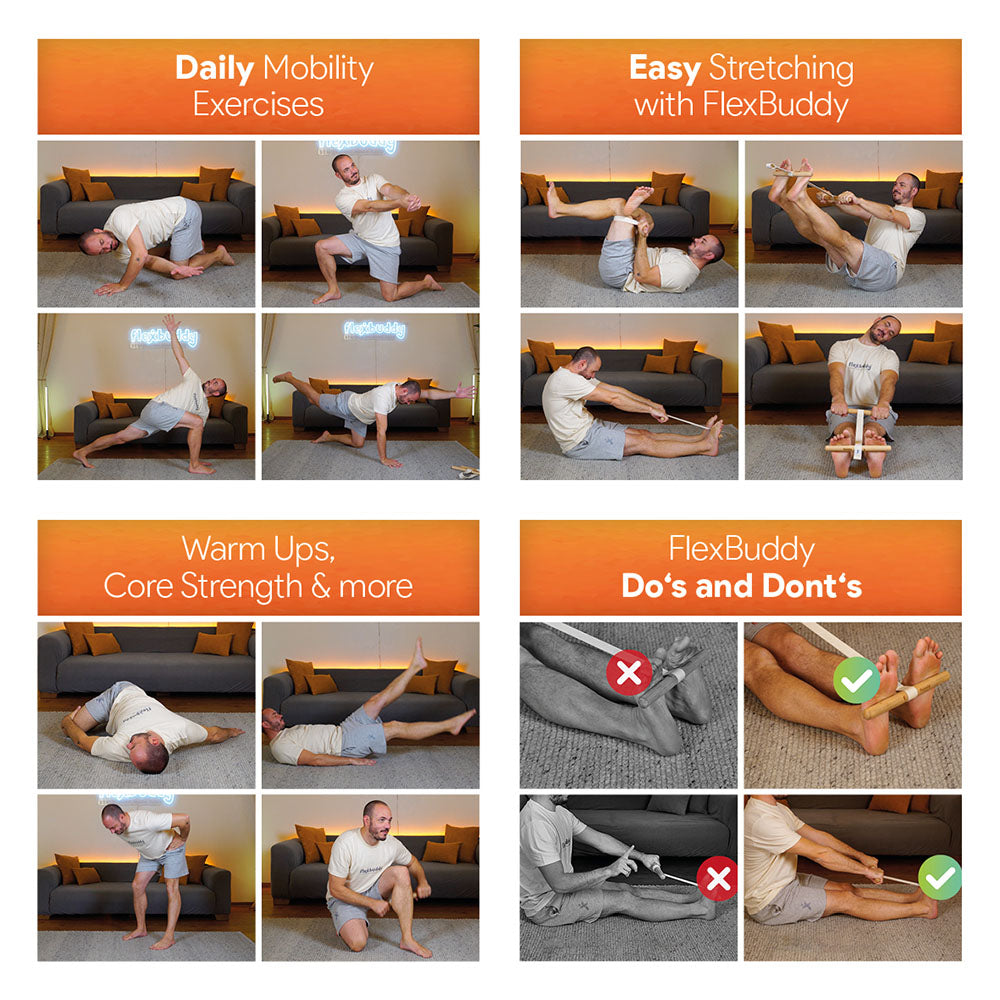
If you own a FlexBuddy, this is the routine from the guide, in the order that works for stiff beginners. Each one is done sitting or lying down, with the strap hooked around the soles of the feet and the wooden handles in your hands.
1. Hamstrings Warm Up (30–45 seconds)
Sit on the floor with your legs extended and hook FlexBuddy around the soles of your feet. Hold the handles with a relaxed grip and sit as tall as you comfortably can. Gently rock forward and back in a small range, letting the strap guide the movement, breathing slowly. You should feel a light, moving pull along the back of the thighs and almost nothing in your lower back. Slightly bent knees are not cheating; they keep the stretch in the hamstrings instead of behind the knees.
2. Static Stretch (20–40 seconds, twice)
Same position. Inhale and lengthen your spine; exhale and hinge forward from the hips, arms long on the handles. Stop at mild tension, the point where you can still breathe slowly, and stay. If your lower back is what complains, you have rounded: ease up and re-lengthen the spine. Measure success by how calm the stretch feels at the depth you chose, not by how far forward you got.
3. Single Leg Stretch (20–30 seconds per side)
Sit with one leg extended and the other knee bent, foot resting inside. Hook FlexBuddy around the extended foot, inhale tall, exhale and hinge gently towards the straight leg. Very often you will discover that one side is tighter; uneven hamstrings pull the pelvis unevenly too, so give the tighter side one extra round.
4. Lying Thigh Stretch (20–30 seconds per side)
Lie on your side or front and hook FlexBuddy around the top foot; hold the handles over your shoulder and draw the heel gently towards the glutes, knees close together, pelvis neutral, no arching. This stretches the front of the thigh and the hip flexors, the other side of the pelvic tug-of-war: the hip flexors pull the pelvis forward, the hamstrings pull it back, and stretching only one side is half a solution.
A four-week progression
Consistency does the work. Two minutes a day beats twenty minutes on Sunday, partly because the first changes are in how much stretch your nervous system will tolerate rather than in the muscle's length, and tolerance is trained by repetition [9].
- Week 1, learn the position. Seated straight-back stretch, 3 holds of 10 breaths, every day. Use a strap or a device so you can keep the chest up without reaching. Stop where you feel the thighs, not the back.
- Week 2, add the lying stretch. Same seated holds, plus the lying single-leg stretch, 2 holds per leg, after work or before bed. Most people notice the evening back-ache easing around now.
- Week 3, shorten the range by one step. Move the strap a loop shorter or your hands a little further down. Only if the back stays long. Add the standing step stretch after any run or ride.
- Week 4, re-test. Repeat the three self-tests and compare the centimetres. Then keep going: the research on long-term programmes is thin [9], but the practical experience is unanimous, which is that the range stays only as long as the habit does.
Be patient with the toes. One Amazon reviewer put it well: after eight weeks of three minutes a day he was not yet at his toes, "though there is progress". Progress is the point; the toes are a milestone.
Hamstrings, sitting and your working day
If you sit for a living, the single most useful change is not a better chair. In a 12-month cluster-randomised trial of 563 healthy office workers with below-normal trunk flexibility or endurance, a programme of daily stretching and twice-weekly endurance training cut new episodes of low back pain from 19.7% to 8.8%, a hazard ratio of 0.37 [8]. Daily stretching was part of the recipe. The ACSM position stand adds that breaking up sitting with frequent short bouts of standing and movement has health benefits even for people who exercise [6]. So: stand up every hour, and give the hamstrings their two minutes at the end of the day, when they have been short for the longest.
When not to stretch, and when to see someone
Do not stretch through pain. If the pull runs down the leg as a burn, tingling or numbness rather than a thigh stretch, the sciatic nerve is involved; nerve-related tightness responds to gentle nerve-gliding movements, not to long holds, and a physiotherapist should set those up. A recent hamstring strain (sudden pain during a sprint or a kick, bruising, weakness) should not be stretched hard in the first days. And some back pain needs a doctor before any exercise: pain with numbness or weakness in the legs, changes in bladder or bowel control, fever, unexplained weight loss, pain after a fall or accident, or pain that keeps getting worse. Those are the small minority of cases that are not "non-specific" [2][3], and they are the reason the red-flag list exists.
Doing this with FlexBuddy
Everything in this article comes down to one position: a long spine folding at the hips while the legs stay straight. That is hard to hold with your hands on your shins, and a towel slips and burns. FlexBuddy® is a stretching device made of two beech-wood bars joined by an adjustable cotton strap. One bar goes under the soles of your feet, the other in your hands; you sit tall, lean back and tilt the hips, and the strap carries the pull so your back does not have to round to reach. The foot bar moves between loops for big changes of length and the hand bar rolls the strap for small ones, so a stiff beginner starts long and shortens a loop a week, exactly the progression above. The wooden handles do not cut into the hands the way a strap does, and the whole thing fits in a bag. Ten slow breaths, three times, is the routine; it takes about two minutes. "Sit at a desk 9 hours a day. My lower back used to ache every evening. Two weeks in, that's basically gone," wrote one owner. It comes with a lifetime warranty and a 30-day money-back guarantee. See FlexBuddy, or take the two-minute quiz to find the routine for your kind of stiffness.
Frequently asked questions
Can tight hamstrings cause lower back pain?
They are linked, but the evidence that tightness causes back pain is weak [4]. What is better supported is that stretching the hamstrings reduces back pain: a 2024 meta-analysis of 14 trials found a moderate reduction in pain and an improvement in function [5].
How long should I hold a hamstring stretch?
About 60 seconds of total stretch per muscle group per session, for example 15 seconds four times or 20 seconds three times, on at least two to three days a week [6][7]. Stretch to mild tightness, never pain. The full dose by goal is in how long to hold a stretch.
Why are my hamstrings so tight even though I stretch?
Usually one of four things: you stretch with a rounded back so the hamstrings never reach their end range; you stretch too hard and the muscle guards; you stretch rarely; or the tightness is partly neural and needs a different approach. If you sit most of the day, the companion guide on lower back pain from sitting covers the hip-flexor side.
How long does it take to loosen tight hamstrings?
Days to feel it, weeks to measure it. Early gains come mostly from a change in what you tolerate rather than from longer fibres [9], which is why a short daily habit works better than occasional long sessions.
Should I stretch tight hamstrings if I have sciatica?
Only gently, with a straight spine, without pain radiating down the leg, and ideally after a physiotherapist has checked you. Nerve-related tightness responds to nerve glides rather than long holds.
This article is general information, not medical advice. Tight muscles usually respond well to regular stretching. If your pain is sharp, radiates down a leg, comes with numbness, weakness, fever, bladder or bowel changes, follows an injury, or keeps getting worse, see a doctor or physiotherapist before you stretch.
References
- Jones O. Muscles of the Posterior Thigh: Hamstrings. TeachMeAnatomy. https://teachmeanatomy.info/lower-limb/muscles/thigh/hamstrings/ (accessed 4 Nov 2026).
- Hartvigsen J, Hancock MJ, Kongsted A, et al.; Lancet Low Back Pain Series Working Group. What low back pain is and why we need to pay attention. Lancet. 2018;391(10137):2356–2367. doi:10.1016/S0140-6736(18)30480-X
- Koes BW, van Tulder MW, Thomas S. Diagnosis and treatment of low back pain. BMJ. 2006;332(7555):1430–1434. doi:10.1136/bmj.332.7555.1430
- Hori M, Hasegawa H, Takasaki H. Comparisons of hamstring flexibility between individuals with and without low back pain: systematic review with meta-analysis. Physiother Theory Pract. 2021;37(5):559–582. doi:10.1080/09593985.2019.1639868
- Gou Y, Lei H, Chen X, Wang X. The effects of hamstring stretching exercises on pain intensity and function in low back pain patients: a systematic review with meta-analysis of randomized controlled trials. SAGE Open Med. 2024;12:20503121241252251. doi:10.1177/20503121241252251
- Garber CE, Blissmer B, Deschenes MR, et al.; American College of Sports Medicine. Position stand: quantity and quality of exercise for developing and maintaining cardiorespiratory, musculoskeletal, and neuromotor fitness in apparently healthy adults. Med Sci Sports Exerc. 2011;43(7):1334–1359. doi:10.1249/MSS.0b013e318213fefb
- Harvard Health Publishing. The ideal stretching routine. Harvard Medical School, 16 Mar 2026 (reviewed by H. E. LeWine, MD). https://www.health.harvard.edu/staying-healthy/the-ideal-stretching-routine (accessed 4 Nov 2026).
- Sihawong R, Janwantanakul P, Jiamjarasrangsi W. A prospective, cluster-randomized controlled trial of exercise program to prevent low back pain in office workers. Eur Spine J. 2014;23(4):786–793. doi:10.1007/s00586-014-3212-3
- Weppler CH, Magnusson SP. Increasing muscle extensibility: a matter of increasing length or modifying sensation? Phys Ther. 2010;90(3):438–449. doi:10.2522/ptj.20090012