- You can know your number tonight. Four home tests cover hamstring flexibility: the sit-and-reach, the active knee extension (popliteal angle), the straight-leg raise and the toe-touch with a ruler. You need a tape measure, a step and a phone.
- Not reaching your toes is normal, and you can change it. A toe touch scores 26 cm on the standard sit-and-reach scale. In a national Canadian survey the median man in his early twenties scored 24.6 cm and the median woman 31.1 cm [1].
- The sit-and-reach is the classic for good reason. Across 34 studies its score tracked direct measurements of the hamstrings [2]. The knee extension test isolates them.
- Know where you start. Healthy students stopped on average about 18 degrees (men) and 13 degrees (women) short of a straight knee on the active test [3]. Your own baseline counts most.
- Real progress is 4 to 5 cm, or about 10 degrees. A gain that size is real, not a good day [4][5]. Retest every two weeks.
- FlexBuddy® is how you move the number. It keeps your spine straight while your hamstrings and calves stretch, and its strap loops show your progress.
What does "hamstring flexibility" actually mean?
The hamstrings are three muscles on the back of the thigh. They start at the ischial tuberosity, the bony point you sit on, and attach just below the knee on the tibia and the fibula; together they extend the hip and bend the knee [6]. A muscle group that works on two joints is tested by fixing one joint and moving the other. Every test here either keeps the knee straight and folds the hip (sit-and-reach, straight-leg raise, toe-touch), or holds the hip at a right angle and straightens the knee (active knee extension).
Why your range can improve fast
A tight muscle is usually pictured as a rope that is too short. The research is far more encouraging. A review in the journal Physical Therapy concluded that the extra range seen after a single stretching session, and after programmes of three to eight weeks, comes mostly from a change in sensation: you tolerate more stretch before calling a stop [7]. That is why the first centimetres can arrive within weeks.
So each of these tests ends at a feeling, not at a mechanical stop. Choose "a firm pull, short of pain" and keep to it. The reasons behind the stiffness are in why you can't touch your toes.
Before you test: kit and ground rules
Kit: a tape measure, a step or a sturdy box, a phone with a spirit-level app, and a notebook.
- Same conditions. Same time of day, same room, same clothes, so that when the number moves you know it was you.
- Same warm-up, or none. A warm-up can improve the result, so repeat whatever you did the first time [8]. The Canadian survey below had people stretch each leg twice for 20 seconds before measuring [1].
- Slow, no bouncing. Hold the end position for one to two seconds while the distance is read [8].
- Knees straight in every test except the knee extension test.
- Two attempts, keep the better one [1].
Do not test a recently injured leg (see pulled hamstring or tight hamstring). Stop if the pull turns into sharp pain, or into burning, tingling or numbness below the knee: that pattern points to an irritated nerve and needs a professional, not a tape measure.
The sit-and-reach test: how to do it at home
The sit-and-reach goes back to a 1952 paper by Wells and Dillon [8]. The classic version uses a box with a scale on top.
- Shoes off. Sit with both legs straight and your soles flat against the box.
- Put one hand on top of the other, palms down, fingertips level.
- Reach forward slowly along the scale as far as you can, knees pressed flat.
- Hold for one to two seconds and read the distance at your fingertips to the nearest centimetre [8].
- Rest, repeat once, write down the better score.
Sit-and-reach without a box: the ruler version
A sit-and-reach box is a box with a ruler on top. Use the bottom stair or a sturdy box pushed against a wall. Lay the tape measure on top, pointing towards you, and fix it so that the 26 cm mark sits exactly above the surface your soles press against. A reach that just gets to your toes now reads 26 cm, which matches the Canadian protocol used for the table below [1]. With no box at all, tape a line on the floor, put your heels on it with your toes pointing up, and lay the tape measure between your legs with 26 cm on the line. That is plenty for tracking yourself.
Why your score may not match someone else's
Different versions put zero in different places. The simplest puts zero at the feet, so stopping short of the toes gives a negative number. The US President's Challenge version puts zero 23 cm in front of the feet and the Eurofit version 15 cm in front [8]; the Canadian protocol scores a toe touch as 26 cm [1]. The same reach, 2 cm past the toes, is +2, 25, 17 or 28 depending on the box. Convert before you compare.
Sit-and-reach norms by age and sex
This table comes from Statistics Canada's journal Health Reports: a nationally representative sample of Canadians measured in 2016 and 2017 [1]. P20 means one person in five scored lower, P50 is the median, and P80 means only one in five scored higher.
| Age | Men P20 | Men P50 | Men P80 | Women P20 | Women P50 | Women P80 |
|---|---|---|---|---|---|---|
| 20–24 | 15.5 | 24.6 | 33.5 | 22.9 | 31.1 | 38.8 |
| 30–34 | 15.3 | 24.2 | 32.9 | 22.0 | 31.0 | 39.3 |
| 40–44 | 14.9 | 23.3 | 31.6 | 20.8 | 30.2 | 38.8 |
| 50–54 | 14.3 | 22.1 | 29.8 | 19.6 | 29.1 | 37.8 |
| 60–64 | 13.7 | 20.9 | 28.0 | 19.1 | 28.8 | 37.6 |
| 65–69 | 13.4 | 20.3 | 27.1 | 19.0 | 28.9 | 37.7 |
Scores in centimetres; a toe touch scores 26 cm. Source: Hoffmann and colleagues, Health Reports 2019, Table 3 [1].
How to read your score
- Women reach further than men at every age, by 6 to 9 cm at the median [1].
- Age is not the obstacle. Between the early twenties and the late sixties the median falls by only about 4 cm in men and 2 cm in women; the authors call sit-and-reach flexibility relatively stable with age [1]. It is never too late.
- Touching your toes puts a man above average. The male median is below 26 cm in every age group. The median woman passes her toes by 3 to 5 cm [1].
- A good score is at or above the median for your age and sex.
These adults had done a short warm-up, so a cold test at home will tend to read lower. Wherever you land, it is a starting point. Bob J. wrote: "I am 64 and have never touched my toes. FlexBuddy changed that in a week!"
What the sit-and-reach tells you
A 2014 meta-analysis pooled 34 studies that compared sit-and-reach scores with direct angle measurements. The scores tracked the hamstrings, with corrected correlations of 0.46 to 0.67 depending on the version. The classic version performed best, and the plain end score beat the versions that try to correct for arm length [2].
Its great strength is repeatability: in university students, single-trial reliability was 0.89 to 0.98 across several versions [9]. That makes it an excellent ruler for watching yourself improve.
One tip keeps the score honest. You can gain centimetres by rounding your back harder, but that sends the stretch into the spine instead of the legs, as the guide to tight hamstrings and lower back pain explains. Reach with a long back. That is what FlexBuddy is built for: the strap carries the pull, your back stays long, and the stretch lands in the hamstrings and calves.
The active knee extension test (popliteal angle) at home
This is the test physiotherapists use when they want the hamstrings on their own. The hip is held at 90 degrees and the knee is straightened; the angle by which the knee falls short of straight is the result. Gajdosik and Lusin described it in 1983, and test and retest agreed almost perfectly (reliability .99 for both legs) [10].
- Lie on your back. Keep one leg flat and straight; it must not lift.
- Bring the other thigh to vertical, knee bent, and clasp your hands behind it. Check with the phone: a vertical thigh reads 90 degrees from horizontal.
- Keeping the thigh still, straighten the knee with your own muscle power until a firm pull in the back of the thigh stops it.
- A helper rests the long edge of the phone along your shin bone and reads the angle. On your own, film from the side and measure on a still frame.
- Your result is how far the shin is from vertical: 65 degrees from horizontal is 25 degrees short of straight. Test both legs.
The popliteal angle is the same idea measured passively: someone else straightens the knee.
What 20 to 30 degrees short of straight means
It means you are in healthy company, with room to gain.
- In students aged 18 to 24, the active test averaged 17.8 degrees short of straight in men and 13.4 in women; the authors proposed calling hamstrings short above 33 degrees in men and about 23 in women [3].
- In healthy volunteers with a mean age of 36, the passive popliteal angle averaged about 35 degrees, and 30% measured more than 40 [11].
- In adults aged 20 to 79, women were 11 degrees more flexible than men, and age made no difference [12].
So 20 to 30 degrees sits inside the range of healthy averages: mid-range for a man, towards the stiff end for a woman. Under about 15 degrees is good by any of these studies.
One tip: in a comparison of measuring methods, a smartphone app needed a difference of 12 degrees before two readings could be called different [13]. With a phone, count gains of 12 degrees or more.
The straight-leg raise and what 80 degrees means
Lie on your back with both legs straight. A helper lifts one leg by the heel, knee straight, until you feel a firm pull, the knee starts to bend or the other leg starts to lift. Rest the phone on the shin and read the angle from the floor. On your own, put the FlexBuddy foot bar under the sole, or loop a belt around the foot, and pull.
The number attached to this test is 80. A criterion widely used in research classes 80 degrees or more as normal and less as tight. A 2023 study of physically active young men applied it, and about half of them landed below the line [14]. If you are under 80, you are in sporty company.
In healthy young adults the average passive straight-leg raise was about 73 degrees [4], and women averaged 8 degrees more than men [12]. Make 80 degrees your target.
Clinicians also use this movement to put tension on the sciatic nerve. A pull in the back of the thigh is hamstring. Pain or tingling that shoots below the knee is not a flexibility reading. Stop there.
The toe-touch test with a ruler (fingertip-to-floor)
Stand barefoot, feet together, knees straight. Bend forward slowly, let your arms hang, and have someone measure the gap between your middle fingertip and the floor. If you can reach the floor, stand on a step and measure how far your fingertips pass its edge; record that as a negative number.
Clinicians call this the fingertip-to-floor test. In a hospital study of people with chronic low back pain, the result tracked trunk flexion measured on X-ray very closely (a correlation of −0.96), and repeat measurements agreed almost perfectly (an intraclass correlation of 0.99) [15].
It measures your whole forward bend, spine and hips together. To see how much of it is hamstring, repeat the test with slightly bent knees. If you suddenly reach much further, the hamstrings were the limit. The plan for closing the gap is in how to touch your toes.
How much change is real?
Every measurement wobbles a little. Researchers put a number on that wobble, the minimal detectable change: the smallest difference that exceeds the measurement error with 95% confidence. Beat that number and your progress is real.
| Test | Real progress starts at | Who was measured |
|---|---|---|
| Sit-and-reach | 3.4 to 4.5 cm | Healthy young adults [4] |
| Toe-touch | 3.8 to 4.8 cm | Healthy young adults [4] |
| Fingertip-to-floor | 4.5 cm | Adults with recent low back pain [5] |
| Straight-leg raise | 10 to 11 degrees | Healthy young adults [4] |
| Passive knee extension | 9 to 10 degrees | Healthy young adults [4] |
| Knee angle by phone app | 12 degrees | Clinicians measuring knees [13] |
These tests are highly consistent: repeat measurements by trained testers agreed with a reliability of 0.92 to 0.99 [4]. A working rule: once you have gained 4 to 5 cm or 10 degrees, it is real. A smaller gain counts when it points the same way on two retests in a row. The error on a single reach reading was 1.2 to 1.8 cm [4], so a score 1 cm lower than last time is the same score.
A retest schedule and a tracking table
Test once at the start, then every two weeks. A fortnight gives your gain time to grow larger than the wobble, and five readings over eight weeks show a trend you can be proud of.
Between tests, stretch. The American College of Sports Medicine recommends flexibility exercises for each major muscle-tendon group, a total of 60 seconds per exercise, on at least two days a week [16]. With FlexBuddy that is two holds of ten deep breaths in the basic posture: sit tall, lean back, tilt the hips forward. A realistic timeline is in how long it takes to get flexible.
| Week | Date | Sit-and-reach (cm) | Toe-touch (cm from floor) | Knee extension L / R (degrees short) | Strap or loop setting | Notes |
|---|---|---|---|---|---|---|
| 0 | ||||||
| 2 | ||||||
| 4 | ||||||
| 6 | ||||||
| 8 |
Use the notes column for the time of day, the warm-up and anything unusual. Compare week 8 with week 0, not with last time. Watching your own numbers climb is the best motivation there is.

Move your numbers with FlexBuddy
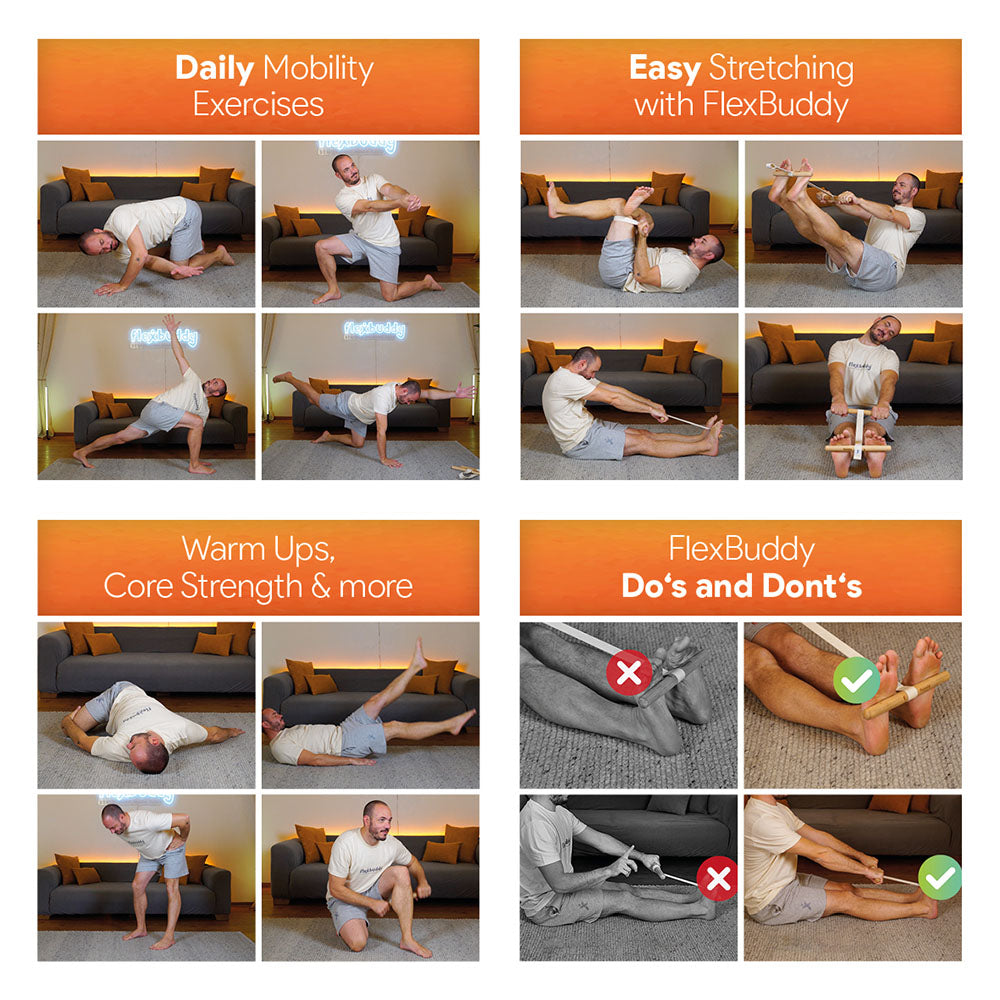
A test tells you where you are. FlexBuddy® takes you further. It is a patented stretching device made of two beech-wood bars joined by an adjustable cotton strap: one bar sits under the soles of your feet, the other in your hands. You sit tall, tilt the hips forward, and the strap carries the pull, so the stretch lands in your hamstrings and calves while your spine stays straight.
It is also a ruler you use every day. The foot bar moves from loop to loop for the big changes in length, and rolling the strap around the hand bar makes the fine ones. Write both in the tracking table: the loop the foot bar is in, and the turns on the hand bar when you sit tall and feel the first firm pull. Start long. When that feels easy for ten slow breaths, move one loop shorter and note the date. Stylianos T. measured his: "It has changed my life! I can now bend 15 cm more than before in the space of 6 months." Two minutes a day can improve your flexibility and posture. FlexBuddy is rated 4.5 by verified buyers and comes with a 30-day money-back guarantee and a lifetime warranty, so you can try it without risk. Get your FlexBuddy, or take the two-minute quiz to find a starting routine for your level.
Frequently asked questions
What is a good sit and reach score?
On the scale where a toe touch scores 26 cm, a good score is at or above the median for your age and sex: about 20 to 25 cm for men and 29 to 31 cm for women in Canadian survey data. The most flexible fifth score above about 27 to 34 cm (men) and 38 to 39 cm (women), depending on age [1].
What are the sit and reach test norms by age?
They hold up far better than most people assume. The male median falls from 24.6 cm at 20 to 24 to 20.3 cm at 65 to 69, and the female median from 31.1 cm to 28.9 cm [1]. Sex matters more than age: women outscore men by 6 to 9 cm at the median [1].
How do I test hamstring flexibility at home?
Use two tests. The sit-and-reach, with a tape measure fixed to a step, tracks your overall forward reach. The active knee extension test, lying on your back with the thigh vertical and a phone level app on the shin, isolates the hamstrings. Record both every two weeks in the same conditions, and stretch with FlexBuddy in between.
Is the toe touch test accurate?
Yes. It is highly repeatable, and in patients with low back pain it agreed closely with trunk flexion measured on X-ray [15]. It measures your whole forward bend, spine and hips together, and a gain of 4 to 5 cm is real progress [4][5].
What is a normal popliteal angle?
There is a healthy range, not a single value. Averages run from about 13 to 18 degrees short of a straight knee on the active test in students [3] to about 35 degrees on a passive test in adults with a mean age of 36, of whom 30% measured over 40 [11]. Women are on average more flexible than men [12].
This article is general information, not medical advice. Tight muscles usually respond well to regular stretching. If your pain is sharp, radiates down a leg, comes with numbness, weakness, fever, bladder or bowel changes, follows an injury, or keeps getting worse, see a doctor or physiotherapist before you stretch.
References
- Hoffmann MD, Colley RC, Doyon CY, Wong SL, Tomkinson GR, Lang JJ. Normative-referenced percentile values for physical fitness among Canadians. Health Rep. 2019;30(10):14–22. doi:10.25318/82-003-x201901000002-eng. Table 3 (sit-and-reach percentiles by age group and sex): https://www150.statcan.gc.ca/n1/pub/82-003-x/2019010/article/00002/tbl/tbl03-eng.htm (accessed 4 Nov 2026).
- Mayorga-Vega D, Merino-Marban R, Viciana J. Criterion-related validity of sit-and-reach tests for estimating hamstring and lumbar extensibility: a meta-analysis. J Sports Sci Med. 2014;13(1):1–14. PMID 24570599. https://pmc.ncbi.nlm.nih.gov/articles/PMC3918544/ (accessed 4 Nov 2026).
- Yıldırım MŞ, Tuna F, Demirbağ Kabayel D, Süt N. The cut-off values for the diagnosis of hamstring shortness and related factors. Balkan Med J. 2018;35(5):388–393. doi:10.4274/balkanmedj.2017.1517
- Liu H, Shen Y, Xiong Y, et al. Psychometric properties of four common clinical tests for assessing hamstring flexibility in young adults. Front Physiol. 2022;13:911240. doi:10.3389/fphys.2022.911240
- Ekedahl H, Jönsson B, Frobell RB. Fingertip-to-floor test and straight leg raising test: validity, responsiveness, and predictive value in patients with acute/subacute low back pain. Arch Phys Med Rehabil. 2012;93(12):2210–2215. doi:10.1016/j.apmr.2012.04.020
- Jones O. Muscles of the Posterior Thigh: Hamstrings. TeachMeAnatomy, last updated 9 Apr 2026. https://teachmeanatomy.info/lower-limb/muscles/thigh/hamstrings/ (accessed 4 Nov 2026).
- Weppler CH, Magnusson SP. Increasing muscle extensibility: a matter of increasing length or modifying sensation? Phys Ther. 2010;90(3):438–449. doi:10.2522/ptj.20090012
- Topend Sports. Sit and Reach Flexibility Test (protocol and scoring variations; original test: Wells KF, Dillon EK. Res Q. 1952;23:115–118). https://www.topendsports.com/testing/tests/sit-and-reach.htm (accessed 4 Nov 2026).
- Hui SS, Yuen PY. Validity of the modified back-saver sit-and-reach test: a comparison with other protocols. Med Sci Sports Exerc. 2000;32(9):1655–1659. doi:10.1097/00005768-200009000-00021
- Gajdosik R, Lusin G. Hamstring muscle tightness: reliability of an active-knee-extension test. Phys Ther. 1983;63(7):1085–1090. doi:10.1093/ptj/63.7.1085
- Moon SJ, Choi Y, Chung CY, et al. Normative values of physical examinations commonly used for cerebral palsy. Yonsei Med J. 2017;58(6):1170–1176. doi:10.3349/ymj.2017.58.6.1170
- Youdas JW, Krause DA, Hollman JH, Harmsen WS, Laskowski E. The influence of gender and age on hamstring muscle length in healthy adults. J Orthop Sports Phys Ther. 2005;35(4):246–252. doi:10.2519/jospt.2005.35.4.246
- Hancock GE, Hepworth T, Wembridge K. Accuracy and reliability of knee goniometry methods. J Exp Orthop. 2018;5(1):46. doi:10.1186/s40634-018-0161-5
- Encarnación-Martínez A, García-Gallart A, Pérez-Soriano P, Catalá-Vilaplana I, Rizo-Albero J, Sanchis-Sanchis R. Effect of hamstring tightness and fatigue on dynamic stability and agility in physically active young men. Sensors (Basel). 2023;23(3):1633. doi:10.3390/s23031633
- Perret C, Poiraudeau S, Fermanian J, Colau MM, Benhamou MA, Revel M. Validity, reliability, and responsiveness of the fingertip-to-floor test. Arch Phys Med Rehabil. 2001;82(11):1566–1570. doi:10.1053/apmr.2001.26064
- Garber CE, Blissmer B, Deschenes MR, et al.; American College of Sports Medicine. Position stand: quantity and quality of exercise for developing and maintaining cardiorespiratory, musculoskeletal, and neuromotor fitness in apparently healthy adults. Med Sci Sports Exerc. 2011;43(7):1334–1359. doi:10.1249/MSS.0b013e318213fefb