- There is no "perfect posture". Reviews find no strong evidence that the shape of your spine predicts back or neck pain [1][2][3]; about nine in ten cases of low back pain have no identifiable structural cause [4].
- The link is tighter at the neck than at the lower back: adults with neck pain do carry the head further forward on average [5]; people with low back pain have the same pelvic tilt and lumbar curve as people without it [6][7].
- Posture does change with training: pooled trials show exercise moves the head and shoulders back and the upper back straighter [8][9]. Strength does most of the work (chin tucks, rows, hip extension); stretching helps where a muscle is genuinely short (chest, hip flexors, hamstrings).
- Braces and posture shirts hold you in a shape but there is no good evidence they reduce pain [10]. "Sit up straight" lasts minutes. Variety beats any single position.
- Expect to feel different within days and to measure a change over months: the trials that moved posture ran for 16 weeks to six months [11][12].
What posture is, and what "perfect posture" is not
Posture is simply the position your body is in right now. It is not a fixed trait, and there is no single correct version of it. The spine has three natural curves, inwards at the neck, outwards at the upper back and inwards again at the lower back, and their size varies enormously between healthy people. When researchers pooled 54 studies on spinal curves and health, they found no strong evidence of a link with any outcome, including spinal pain, and rated the few associations they did find as unlikely to be causal [2].
That matters because a large industry sells the opposite message. A 2019 viewpoint in the Journal of Orthopaedic and Sports Physical Therapy put it bluntly: the belief that spinal pain is caused by sitting, standing or bending "incorrectly" is widespread and not supported by strong evidence, yet has produced a flourishing market of products that claim to correct posture and prevent pain, and many clinicians still give advice in line with it [1].
So the honest starting point is this. Your posture is a habit, not a diagnosis. It can be changed, and some changes are worth making because they feel and look better. But if you were told your posture is the reason your back hurts, the evidence for that is weaker than you have been led to think.
Does bad posture cause pain?
It depends which part of the body you ask about. The neck and the lower back behave differently in the research, and lumping them together is where most posture advice goes wrong.
Neck and forward head posture
Forward head posture, where the ears sit in front of the shoulders, is the most studied pattern. A 2019 review of 15 cross-sectional studies found that adults with neck pain did hold the head further forward than adults without it, by a small but statistically significant margin, and that in adults a more forward head correlated with more pain and disability; in adolescents it did not [5].
That adolescent result matters, because it is where the best long-term data come from. In 1,108 Australian 17-year-olds photographed while sitting, researchers identified four distinct neck postures, from upright through to slumped with the head forward, and found no difference in the odds of neck pain or headache between them [13]. When 686 of the same young people were followed up at 22, the pattern became stranger still: in young women, the more relaxed, slumped postures at 17 carried a lower risk of persistent neck pain at 22 than the upright posture, and in young men posture made no difference at all [14]. The authors concluded that public health messages to sit up straight to prevent neck pain "need rethinking" [14].
Together: adults with neck pain tend to have a more forward head, but nobody knows which comes first. Pain may pull the head forward just as plausibly as the head position produces the pain, and in people not yet in pain a forward head is not a reliable predictor of trouble.
Lower back and anterior pelvic tilt
For the lower back the evidence points away from posture. An umbrella review of 41 systematic reviews on spinal posture, sitting, standing, bending and low back pain found mixed associations, no consistent evidence that these factors precede a first episode, and no consensus on causation [3]. A meta-analysis of 43 studies found people with low back pain had no difference in standing pelvic tilt or lumbar curve; what they showed was less range of movement, slower movement and poorer sense of position [6]. People in pain move less, not more crookedly.
Anterior pelvic tilt in particular gets blamed for a great deal. In 120 healthy, pain-free young adults, 85% of the men and 75% of the women had an anterior pelvic tilt [15]. It is the normal shape of a human pelvis, not a fault. And when a meta-analysis of 13 studies compared the lumbar curve in 796 people with low back pain and 927 without, the back-pain group had on average a smaller curve, a flatter lower back, not the exaggerated arch that "anterior tilt causes back pain" would predict [7]. The background is in does stretching help back pain; the short version is that about 90% of low back pain is "non-specific", meaning no clear cause can be found [4], and posture has not been shown to be that cause.
The four common posture patterns, with a quick self-check
None of these is a disease. They are habits of position that tend to appear together in people who sit a lot. Do the checks in front of a mirror or with a phone propped sideways.
1. Forward head
The ear sits in front of the shoulder. The muscles at the back of the neck work overtime to hold the skull up, and the small muscles at the front, which should share the job, switch off. Self-check: stand side-on to the camera, relax, and see where your ear canal sits relative to the middle of your shoulder. In front by more than a thumb's width is the pattern. Now slide the head straight back, as if making a double chin: that distance is your working range.
2. Rounded shoulders
The shoulders roll forward and inwards and the shoulder blades drift apart. The muscle most often short here is pectoralis minor, which runs from the third to fifth ribs up to a hook of bone at the front of the shoulder blade and pulls the blade forward and down against the chest wall [16]. Hold the arms over a keyboard for years and it does that job permanently. Self-check: lie on your back on the floor, arms by your sides, and relax. Shoulders that hover above the floor rather than resting on it, or one side higher than the other, point to a short front of the chest.
3. Anterior pelvic tilt
The pelvis tips forward and the lower back arches. The front of the hip is the usual culprit: iliopsoas runs from the lumbar vertebrae and the inside of the pelvis to the top of the thigh bone and flexes the hip [17], and in a chair it spends the day at its shortest length. Some anterior tilt is normal in most healthy people [15], so the question is not whether you have it but whether the hip flexors are short. Self-check: lie on the edge of a bed, hug one knee to your chest and let the other leg hang. If the hanging thigh cannot rest level with the bed, the hip flexors on that side are short. This is the Thomas test; the hip side of the story is in tight hips from sitting.
4. The slump
The whole-body version: head forward, shoulders rounded, upper back curved, pelvis tucked under, the sofa shape. The upper-back curve is called kyphosis; everyone has some, and an exaggerated version (hyperkyphosis) becomes more common with age. Self-check: stand with your back to a wall, heels a hand's width away, bottom and shoulder blades touching. If the back of your head cannot touch the wall without tipping the chin up, your upper back is rounded enough to be worth training. Seated, notice how long you can hold upright before the body slides back into the slump; it is usually not long, which tells you the problem is endurance rather than knowledge.
What actually changes posture
Here the evidence turns positive. The trials that changed posture share a recipe: strength for the muscles that have gone quiet, length for the muscles that have gone short, and enough weeks for either to take.
Movement variety
The cheapest fix is to stop holding any position for long. In the review of office neck pain cited in our desk stretches guide, pooling ten cohort studies and two trials, the risk factors for developing neck pain were low variation in work tasks (risk about 27% higher), a keyboard close to the body (46% higher) and low satisfaction with the workplace (28% higher) [18]. Not one of those is a posture; "low task variation" means you did not move. The American College of Sports Medicine makes the same point: frequent short bouts of standing and activity between periods of sitting have health benefits even in people who exercise [19]. The best posture is the next one.
Strength: chin tucks, rows, hip extension
This is where the trial evidence is strongest. A 2018 meta-analysis of seven randomised trials with 627 participants found strong evidence that corrective exercise improves the craniovertebral angle, the standard measure of forward head posture, and moderate evidence that it reduces neck pain [8]. A 2024 meta-analysis of 22 studies found exercise improved forward head, rounded shoulders and upper-back curve together, with strength work, stretching and whole-pattern programmes all contributing [9]. For the upper back, a meta-analysis of ten randomised trials found a large effect on the kyphosis angle and concluded that strengthening, rather than stretching, is the more relevant ingredient [20]. In adults over 60 with a pronounced upper-back curve, six months of spine-strengthening and posture training reduced the curve on X-ray by three degrees more than a control group, roughly the change a vertebral fracture causes in the other direction [12].
Three movements cover the strength side:
- Chin tucks. Lying on your back, draw the chin straight back and lift the head one centimetre off the floor; hold, lower. This trains the deep muscles at the front of the neck that a forward head lets go idle.
- Rows and shoulder-blade squeezes. Pull the elbows back and the shoulder blades together and down, with a band, a cable or a towel looped round a door handle. This trains the middle and lower trapezius and the rhomboids, the muscles that hold the shoulder blades back against the pull of the chest.
- Hip extension. Glute bridges and hip thrusts. The glutes are the hip flexors' opponents, and a hip that can reach fully behind you does more for pelvic position than any amount of standing tall.
Stretching the parts that are short
Stretching alone has a thinner record than strengthening [20], but it earns its place where a muscle is measurably short, and it makes the strength work possible: you cannot row the shoulder blades back if the chest will not let them go. A single session of soft-tissue work and self-stretching of pectoralis minor reduced rounded-shoulder posture in 28 healthy adults, and the shoulders were still less rounded two weeks later [21]. The hip flexors and hamstrings matter for the pelvis: iliopsoas pulls it forward, the hamstrings, which run from the sitting bone to just below the knee [22], pull it back, and if either is short the pelvis sits where the shorter muscle leaves it. The hold-time numbers are the standard ones: about 60 seconds of total stretch per muscle group, on at least two to three days a week, to mild tension and never pain [19][23].
The hamstring stretch has a posture trap of its own: most people fold forward with a rounded back, which practises the slump while missing the hamstrings. Fold with a long spine and the pelvis tipping forward instead (the technique is in tight hamstrings and lower back pain); holding that straight spine under a leg stretch is what FlexBuddy is designed for.
The workstation
Ergonomics is not posture, but it decides which posture you fall into. The one workstation factor that reliably raised neck-pain risk was a keyboard close to the body [18], which pulls the elbows in and the shoulders forward. When people sat for an hour in each of three positions, leaning forward over the desk produced the most low-back discomfort and the most back-muscle activity; upright sitting produced moderate muscle work and less discomfort [24]. So: screen at eye level, keyboard far enough away that the forearms rest, chair back used rather than perched on. Then change it every half hour anyway.
What does not work, or has weak evidence
Braces, posture correctors and posture shirts
They do change your shape while you wear them: in 38 overhead athletes with forward-head, rounded-shoulder posture, a tensioned scapular brace reduced the forward shoulder angle acutely, though its effect on muscle activity was highly variable [25]. The problem is pain. A 2019 scoping review of posture-correcting shirts found six studies, all in pain-free people, of poor to fair quality with serious risk of bias; the reviewers rated their confidence in the evidence as very low, concluded that use of these garments for musculoskeletal pain is not supported, and warned that promoting them "may reinforce the inaccurate and unhelpful message that poor posture leads to pain" [10]. There is also a mechanical objection: a strap that holds the shoulders back is doing the job of the muscles that should, which is the opposite of training them.
"Just stand up straight"
It works for as long as you remember to, and then the body returns to the position its muscles can sustain. The follow-up study of teenagers found upright sitting did not protect young women from persistent neck pain; relaxed postures were, if anything, associated with less of it [14]. A rigidly held "good" posture is still a held position, and holding is the thing to avoid.
One-off fixes
An adjustment, a single massage, a week of chin tucks: these can feel good and some produce a short-lived measurable change [21], but posture is the sum of thousands of hours in a shape, and the trials that changed it lasted 16 weeks or longer [11][12]. A 2001 review found most exercise programmes simply too short and infrequent to change muscle length, with any gain offset by the hours of daily living that follow [26]. Better-designed trials have since shown that longer programmes do work [8][20], but no single session will.
A 10-minute posture routine
Strength first, stretching second, inside the guideline numbers [19][23]. Do it on at least three days a week; the chin tucks and shoulder-blade squeezes can be sprinkled through any working day too.
| Exercise | Position | Hold / tempo | Reps | What it targets |
|---|---|---|---|---|
| Chin tuck | On your back; slide the chin back, lift the head 1 cm | Hold 5 s | 10 | Deep neck flexors; forward head |
| Wall angel | Back and arms against a wall; slide the arms from "goalpost" to overhead, hands on the wall | Slow, 3 s each way | 10 | Upper back, shoulder blades |
| Band row | Band round a door handle; pull the elbows back, squeeze the shoulder blades together and down | Pause 2 s at the back | 12–15, 2 sets | Middle and lower trapezius, rhomboids; rounded shoulders |
| Glute bridge | On your back, knees bent; lift the hips until straight from knee to shoulder | Hold 3 s at the top | 12–15 | Glutes, hip extension; pelvic position |
| Doorway chest stretch | Forearm on a door frame, elbow at shoulder height; step through until the chest pulls | 30 s | 2 per side | Pectoralis minor and major; rounded shoulders |
| Half-kneeling hip-flexor stretch | One knee on a cushion; tuck the tailbone, shift forward until the front of the hip pulls | 30 s | 2 per side | Iliopsoas, rectus femoris; anterior tilt |
| Seated hamstring stretch, long spine | Sit tall, legs straight, strap or device round the feet; tip the pelvis forward with the chest up | 10 breaths (~30 s) | 3 | Hamstrings; the straight-spine habit |
| Thoracic extension over a rolled towel | Towel across the upper back, hands behind the head; gently arch back over it, breathing out | 5 slow breaths | 3 positions | Upper-back mobility; the slump |
The stretches total about 60 seconds per muscle group, the figure the American College of Sports Medicine and Harvard Health both give [19][23]. With two minutes, do the chin tucks and the band rows; with one, stand up and walk to the kitchen.
How long does it take to fix posture?
Honest timeline, in three layers.
Days. You feel different almost immediately, because you are paying attention and a chest stretch changes the sense of where your shoulders are. That is awareness, not adaptation, and it fades by the afternoon.
Weeks. A single session of chest stretching held its effect for two weeks in one small study [21], which is encouraging but not a permanent change. This is the stage at which the exercises stop feeling awkward and the upright position lasts longer before the slump returns.
Months. The programmes with the clearest results were long. In adolescents, 16 weeks of strengthening and stretching reduced forward head and rounded shoulders [11], and a 32-week version held its gains through a further 16 weeks without training [27]. In adults over 60, six months of three one-hour sessions a week changed the upper-back curve on X-ray [12]. For anterior pelvic tilt nobody has shown much: a systematic review found two randomised trials with 72 participants between them, one reporting a change of under two degrees, and rated the evidence very low [28]. Make tilt comfortable with strong glutes and long hip flexors; do not try to measure it.
What you cannot expect is for a posture change to fix a painful back. The two are more loosely connected than the industry says, which is also the good news: you can have a rounded upper back and a pain-free spine, and most people do.
Doing this with FlexBuddy
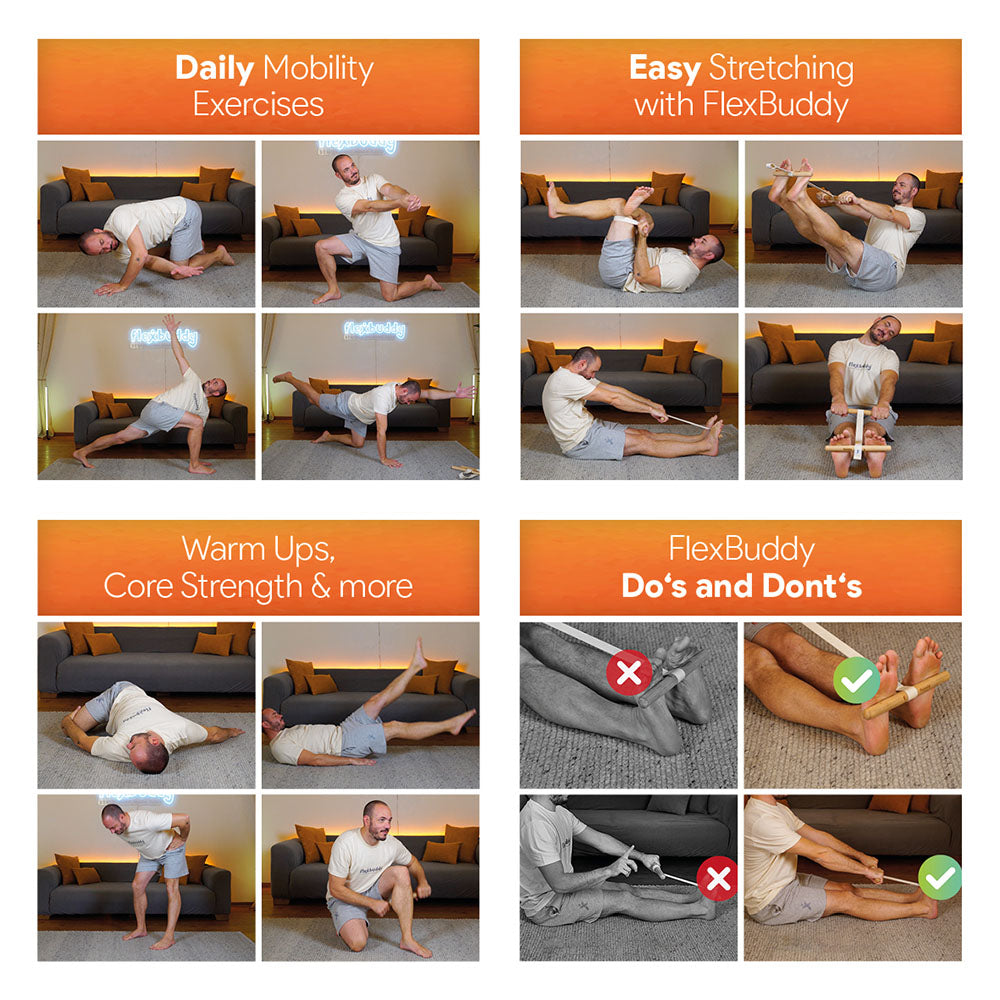
Posture work splits in two. The neck and shoulder half, chin tucks, rows, the chest stretch, needs a wall, a band and a door frame, and no device will do it for you. The pelvis half is where FlexBuddy® earns its place. The seated hamstring stretch in the routine above only trains the right habit if the spine stays long while the pelvis tips forward, and that is exactly the position the device holds: one beech-wood bar under the soles of the feet, one in your hands, a cotton strap between them, so you sit tall, lean back and tilt the hips instead of rounding to reach. The foot bar moves between loops for big changes and the hand bar rolls the strap for small ones, so a stiff beginner starts long and shortens a loop a week; the guide adds a Lying Thigh Stretch for the front of the hip. "A great tool to help your clients maintain a neutral spine while stretching calves, hamstrings and lower back," wrote one trainer. Lifetime warranty, 30-day money-back guarantee. See FlexBuddy, or take the two-minute quiz to find the routine for your pattern.
Frequently asked questions
How do I fix my posture?
Strengthen the muscles that have gone quiet (chin tucks, rows, glute bridges), stretch the ones that have gone short (chest, hip flexors, hamstrings), and change position often. Pooled trials show programmes of this kind move the head, shoulders and upper back measurably over weeks to months [8][9][20].
What are the best forward head posture exercises?
Chin tucks for the deep neck flexors, band rows for the upper back, and a chest stretch so the shoulders can come back. A meta-analysis of seven randomised trials found strong evidence that corrective exercise improves the craniovertebral angle and moderate evidence that it reduces neck pain [8].
Do posture correctors work?
They change your shape while you wear them, but a 2019 review of posture-correcting shirts found only six studies, all in pain-free people, with very low confidence in the evidence, and concluded their use for musculoskeletal pain is not supported [10]. A brace also does the job your muscles should be learning to do.
Does stretching improve posture?
On its own, modestly; with strengthening, yes. A meta-analysis of exercise and spinal curves found strengthening the more relevant ingredient for the upper back [20], while stretching a short chest muscle reduced rounded shoulders for at least two weeks [21]. Stretch what is measurably short and strengthen the opposite side.
How long does it take to fix posture?
You feel different in days, and the clearest measured changes came from four to six months of regular work. The programmes that changed posture in trials ran for 16 weeks in adolescents [11] and six months in older adults [12].
Do rounded shoulders cause pain?
Not reliably. Spinal curves have not been shown to predict pain in large reviews [2][3], and a 16-week programme that reduced rounded shoulders in 130 adolescents did not change their shoulder pain scores [11]. Train them for how you move and feel, not because they are damaging you.
This article is general information, not medical advice. Tight muscles usually respond well to regular stretching. If your pain is sharp, radiates down a leg, comes with numbness, weakness, fever, bladder or bowel changes, follows an injury, or keeps getting worse, see a doctor or physiotherapist before you stretch [29].
References
- Slater D, Korakakis V, O'Sullivan P, Nolan D, O'Sullivan K. "Sit up straight": time to re-evaluate. J Orthop Sports Phys Ther. 2019;49(8):562–564. doi:10.2519/jospt.2019.0610. PMID 31366294 (abstract accessed 4 Nov 2026).
- Christensen ST, Hartvigsen J. Spinal curves and health: a systematic critical review of the epidemiological literature dealing with associations between sagittal spinal curves and health. J Manipulative Physiol Ther. 2008;31(9):690–714. doi:10.1016/j.jmpt.2008.10.004. PMID 19028253 (abstract accessed 4 Nov 2026).
- Swain CTV, Pan F, Owen PJ, Schmidt H, Belavy DL. No consensus on causality of spine postures or physical exposure and low back pain: a systematic review of systematic reviews. J Biomech. 2020;102:109312. doi:10.1016/j.jbiomech.2019.08.006. PMID 31451200 (abstract accessed 4 Nov 2026).
- Koes BW, van Tulder MW, Thomas S. Diagnosis and treatment of low back pain. BMJ. 2006;332(7555):1430–1434. doi:10.1136/bmj.332.7555.1430. https://pmc.ncbi.nlm.nih.gov/articles/PMC1479671/ (accessed 4 Nov 2026).
- Mahmoud NF, Hassan KA, Abdelmajeed SF, Moustafa IM, Silva AG. The relationship between forward head posture and neck pain: a systematic review and meta-analysis. Curr Rev Musculoskelet Med. 2019;12(4):562–577. doi:10.1007/s12178-019-09594-y. PMID 31773477 / PMC6942109 (abstract accessed 4 Nov 2026).
- Laird RA, Gilbert J, Kent P, Keating JL. Comparing lumbo-pelvic kinematics in people with and without back pain: a systematic review and meta-analysis. BMC Musculoskelet Disord. 2014;15:229. doi:10.1186/1471-2474-15-229. PMID 25012528 / PMC4096432 (abstract accessed 4 Nov 2026).
- Chun SW, Lim CY, Kim K, Hwang J, Chung SG. The relationships between low back pain and lumbar lordosis: a systematic review and meta-analysis. Spine J. 2017;17(8):1180–1191. doi:10.1016/j.spinee.2017.04.034. PMID 28476690 (abstract accessed 4 Nov 2026).
- Sheikhhoseini R, Shahrbanian S, Sayyadi P, O'Sullivan K. Effectiveness of therapeutic exercise on forward head posture: a systematic review and meta-analysis. J Manipulative Physiol Ther. 2018;41(6):530–539. doi:10.1016/j.jmpt.2018.02.002. PMID 30107937 (abstract accessed 4 Nov 2026).
- Sepehri S, Sheikhhoseini R, Piri H, Sayyadi P. The effect of various therapeutic exercises on forward head posture, rounded shoulder, and hyperkyphosis among people with upper crossed syndrome: a systematic review and meta-analysis. BMC Musculoskelet Disord. 2024;25(1):105. doi:10.1186/s12891-024-07224-4. PMID 38302926 / PMC10832142 (abstract accessed 4 Nov 2026).
- Palsson TS, Travers MJ, Rafn T, Ingemann-Molden S, Caneiro JP, Christensen SW. The use of posture-correcting shirts for managing musculoskeletal pain is not supported by current evidence: a scoping review of the literature. Scand J Pain. 2019;19(4):659–670. doi:10.1515/sjpain-2019-0005. PMID 31075089 (abstract accessed 4 Nov 2026).
- Ruivo RM, Pezarat-Correia P, Carita AI. Effects of a resistance and stretching training program on forward head and protracted shoulder posture in adolescents. J Manipulative Physiol Ther. 2017;40(1):1–10. doi:10.1016/j.jmpt.2016.10.005. PMID 27842938 (abstract accessed 4 Nov 2026).
- Katzman WB, Vittinghoff E, Lin F, et al. Targeted spine strengthening exercise and posture training program to reduce hyperkyphosis in older adults: results from the study of hyperkyphosis, exercise, and function (SHEAF) randomized controlled trial. Osteoporos Int. 2017;28(10):2831–2841. doi:10.1007/s00198-017-4109-x. PMID 28689306 / PMC5873977 (abstract accessed 4 Nov 2026).
- Richards KV, Beales DJ, Smith AJ, O'Sullivan PB, Straker LM. Neck posture clusters and their association with biopsychosocial factors and neck pain in Australian adolescents. Phys Ther. 2016;96(10):1576–1587. doi:10.2522/ptj.20150660. PMID 27174256 (abstract accessed 4 Nov 2026).
- Richards KV, Beales DJ, Smith AL, O'Sullivan PB, Straker LM. Is neck posture subgroup in late adolescence a risk factor for persistent neck pain in young adults? A prospective study. Phys Ther. 2021;101(3):pzab007. doi:10.1093/ptj/pzab007. PMID 33444448 (abstract accessed 4 Nov 2026).
- Herrington L. Assessment of the degree of pelvic tilt within a normal asymptomatic population. Man Ther. 2011;16(6):646–648. doi:10.1016/j.math.2011.04.006. PMID 21658988 (abstract accessed 4 Nov 2026).
- Jones O. Muscles of the Pectoral Region. TeachMeAnatomy. https://teachmeanatomy.info/upper-limb/muscles/pectoral-region/ (accessed 4 Nov 2026).
- Jones O. Muscles of the Anterior Thigh. TeachMeAnatomy. https://teachmeanatomy.info/lower-limb/muscles/thigh/anterior-compartment/ (accessed 4 Nov 2026).
- Jun D, Zoe M, Johnston V, O'Leary S. Physical risk factors for developing non-specific neck pain in office workers: a systematic review and meta-analysis. Int Arch Occup Environ Health. 2017;90(5):373–410. doi:10.1007/s00420-017-1205-3. PMID 28224291 (abstract accessed 4 Nov 2026).
- Garber CE, Blissmer B, Deschenes MR, et al.; American College of Sports Medicine. Position stand: quantity and quality of exercise for developing and maintaining cardiorespiratory, musculoskeletal, and neuromotor fitness in apparently healthy adults. Med Sci Sports Exerc. 2011;43(7):1334–1359. doi:10.1249/MSS.0b013e318213fefb. PMID 21694556 (abstract accessed 4 Nov 2026).
- González-Gálvez N, Gea-García GM, Marcos-Pardo PJ. Effects of exercise programs on kyphosis and lordosis angle: a systematic review and meta-analysis. PLoS One. 2019;14(4):e0216180. doi:10.1371/journal.pone.0216180. PMID 31034509 / PMC6488071 (abstract accessed 4 Nov 2026).
- Wong CK, Coleman D, diPersia V, Song J, Wright D. The effects of manual treatment on rounded-shoulder posture, and associated muscle strength. J Bodyw Mov Ther. 2010;14(4):326–333. doi:10.1016/j.jbmt.2009.05.001. PMID 20850039 (abstract accessed 4 Nov 2026).
- Jones O. Muscles of the Posterior Thigh: Hamstrings. TeachMeAnatomy. https://teachmeanatomy.info/lower-limb/muscles/thigh/hamstrings/ (accessed 4 Nov 2026).
- Harvard Health Publishing. The ideal stretching routine. Harvard Medical School, 16 Mar 2026 (reviewed by H. E. LeWine, MD). https://www.health.harvard.edu/staying-healthy/the-ideal-stretching-routine (accessed 4 Nov 2026).
- Waongenngarm P, Rajaratnam BS, Janwantanakul P. Perceived body discomfort and trunk muscle activity in three prolonged sitting postures. J Phys Ther Sci. 2015;27(7):2183–2187. doi:10.1589/jpts.27.2183. PMID 26311951 / PMC4540846 (abstract accessed 4 Nov 2026).
- Cole AK, McGrath ML, Harrington SE, Padua DA, Rucinski TJ, Prentice WE. Scapular bracing and alteration of posture and muscle activity in overhead athletes with poor posture. J Athl Train. 2013;48(1):12–24. doi:10.4085/1062-6050-48.1.13. PMID 23672321 / PMC3554027 (abstract accessed 4 Nov 2026).
- Hrysomallis C, Goodman C. A review of resistance exercise and posture realignment. J Strength Cond Res. 2001;15(3):385–390. PMID 11710670 (abstract accessed 4 Nov 2026).
- Ruivo RM, Carita AI, Pezarat-Correia P. The effects of training and detraining after an 8 month resistance and stretching training program on forward head and protracted shoulder postures in adolescents: randomised controlled study. Man Ther. 2016;21:76–82. doi:10.1016/j.math.2015.05.001. PMID 26028408 (abstract accessed 4 Nov 2026).
- Falk Brekke A, Overgaard S, Hróbjartsson A, Holsgaard-Larsen A. Non-surgical interventions for excessive anterior pelvic tilt in symptomatic and non-symptomatic adults: a systematic review. EFORT Open Rev. 2020;5(1):37–45. doi:10.1302/2058-5241.5.190017. PMID 32071772 / PMC7017593 (abstract accessed 4 Nov 2026).
- NHS. Back pain. Page last reviewed 5 March 2026. https://www.nhs.uk/conditions/back-pain/ (accessed 4 Nov 2026).