- Static stretching: take a muscle to mild tension and hold still, usually 10 to 30 seconds. Dynamic stretching: move a joint through its range under control, with no hold, as in leg swings or walking lunges [1].
- Before sport, dynamic wins. A controlled dynamic warm-up increases range of motion and gives small gains in force, power, sprint and jump performance [2][3].
- Static stretching before exercise is not "bad". Holds under 60 seconds per muscle, inside a proper warm-up, change strength and power by about 1 to 2 per cent, trivial unless you are competing [4][5]. Holds of 60 seconds or more on cold muscles cost more [3].
- For flexibility that lasts, static and PNF stretching beat dynamic: a 2024 meta-analysis of 77 studies found larger range-of-motion gains from static and PNF than from ballistic or dynamic stretching [6].
- Stretching does not meaningfully prevent muscle soreness [7], and on its own has not been shown to prevent sports injuries; strength training has [8].
- The rule: move before you train, hold afterwards or on its own, and give flexibility a few minutes most days.
What static and dynamic stretching actually mean
Most of the argument about "which is better" disappears once the definitions are clear.
Static stretching
You take a muscle to the end of its comfortable range, feel mild tension, and stay there. The hold is typically 10 to 30 seconds, repeated two to four times; it can be passive (gravity, a partner or a strap holds you there) or active (your own opposite muscles hold the position) [1]. Four examples:
- Seated hamstring stretch: legs straight, spine long, strap around the feet, hips tipped forward until the thighs pull.
- Standing quadriceps stretch: one hand on a wall, the other holding the ankle behind you, knees together, pelvis tucked.
- Wall calf stretch: hands on a wall, one leg back, heel down, knee straight, lean in.
- Doorway chest stretch: forearms on the door frame, step through until the shoulders open.
Dynamic stretching
You move a joint through its full range, under control, and repeat. There is no hold. The point is to rehearse the movement you are about to do, raise muscle temperature and wake up the nervous system [2]. Four examples:
- Leg swings: one hand on a wall, swing a straight leg forward and back, range growing each swing.
- Walking lunges: long steps, back knee towards the floor, torso tall, alternating legs across the room.
- Arm circles: straight arms drawing large circles forwards, then backwards.
- Hip circles (open the gate): knee to hip height, out to the side and down, as if stepping over a hurdle.
Ballistic and PNF, briefly
Ballistic stretching is dynamic stretching done fast: bouncing at the end of the range. Because the speed raises the risk of injury it is no longer recommended for general use [1], and the research finds bouncy versions less useful than controlled movement [2]. PNF (proprioceptive neuromuscular facilitation) is a static stretch with a contraction built in: you tighten the muscle being stretched, typically at 75 to 100 per cent of maximum for about 10 seconds, then relax and sink deeper. Gentler contractions of 20 to 60 per cent appear to work just as well, and a strap can provide the resistance [1]. PNF is a flexibility tool, not a warm-up tool.
What each one does in the next hour
Both open range, briefly
Static, dynamic and PNF stretching all increase joint range of motion straight away, and the gain typically lasts less than 30 minutes [3]: range for that session, no more.
Static holds can take a little off strength and power
A meta-analysis of 104 studies found that static stretching immediately before a test reduced maximal strength by 5.4 per cent on average, power by 1.9 per cent and explosive performance (sprints, jumps) by 2.0 per cent. The losses grew with stretch time, and the authors concluded that static stretching should not be the only thing in a warm-up [9]. A review of 106 studies drew the line more precisely: holds under 30 seconds had no detrimental effect (minus 1.1 per cent), 30 to 45 seconds had no significant effect (minus 1.9 per cent), and a meaningful drop became likely only at 60 seconds or more [4]. A 2016 review put the methods side by side: performance immediately after static stretching changed by minus 3.7 per cent, after PNF by minus 4.4 per cent, and after dynamic stretching by plus 1.3 per cent. Static holds of 60 seconds or more per muscle group cost 4.6 per cent; under 60 seconds, 1.1 per cent. And when the stretching was followed by dynamic activity, as in any real warm-up, no clear effect remained [3]. The cost of a long hold is partly neural (the nervous system activates the muscle a little less), partly mechanical (a more compliant muscle-tendon unit) and partly psychological: expecting to be weaker can make you weaker [10].
Dynamic stretching warms, loosens and primes
A 2018 review found substantial evidence that dynamic stretching improves range of motion and the performance that follows: force, power, sprint and jump. The larger range comes from reduced stiffness of the muscle-tendon unit; the better performance from higher muscle temperature and the potentiation produced by the contractions involved. It works best at moderate speed and amplitude [2], and within minutes of the activity [3].
What each one does over months
If your goal is to touch your toes, what matters is not the next hour but the next twelve weeks. Here the answer flips.
The largest analysis to date pooled 77 studies and 186 effect sizes on long-term stretch training in healthy people. Stretch training increased range of motion with a moderate effect overall, and the type mattered: PNF and static stretching produced greater gains than ballistic or dynamic stretching. Women gained somewhat more than men, and neither volume, intensity nor weekly frequency was a significant predictor of the gain [6]. An earlier review of 23 long-term studies also favoured static stretching and found that time per week mattered more than time per session: at least five minutes a week over at least five days was the pattern linked with gains [11].
The classic dose trial still holds up: 93 adults aged 21 to 39 with tight hamstrings stretched five days a week for six weeks, and a single 30-second hold once a day improved knee-extension range as much as a 60-second hold or three sessions a day [12]. Regular beats more.
That matches the guidelines. The American College of Sports Medicine recommends about 60 seconds of flexibility exercise per muscle-tendon group on at least two days a week [13], usually read as two to three sessions a week with the 60 seconds made of four 15-second or three 20-second holds [14]. Each stretch is best held 15 to 30 seconds, two to four times, after an active warm-up; older adults may need longer, since 60-second holds produced greater hamstring gains than shorter holds in older adults [1]. Hold times have their own article. And in the first weeks most of the gain is increased stretch tolerance, your nervous system letting you further into the range, rather than a longer muscle [1], which is why consistency beats force.
Static vs dynamic stretching: which is better for what?
"Better" only makes sense next to a goal and a time of day.
| Goal and timing | Use | Why | How |
|---|---|---|---|
| Before a run, a match or a gym session | Dynamic | Warms, opens range, small performance boost [2][3] | 2 to 3 minutes of easy movement, then 5 to 8 minutes of drills. A static hold under 30 seconds on one stubborn muscle is fine if movement follows [4][10] |
| Before maximal lifting, sprinting or jumping | Dynamic only | Long static holds are the ones that cost measurable strength and power [9][4] | Skip static holds, or keep them under 30 seconds and early in the warm-up [5] |
| After a workout | Static | Muscles are warm and there is no performance to protect | 15 to 30 seconds, 2 to 4 repetitions per muscle group [1]. It will feel good; it will not prevent soreness [7] |
| To become more flexible | Static or PNF | Largest long-term gains in range of motion [6] | About 60 seconds per muscle group, most days [13][11]. Two minutes a day covers hamstrings and calves |
| Stiffness from sitting | Static, plus movement breaks | Muscles held short all day need time at length; joints need to move | A straight-spine static routine in the evening; hip circles and a few lunges every hour at the desk |
| Non-specific muscle pain (tight hamstrings, achy lower back) | Gentle static | Hamstring stretching reduced pain in trials of people with low back pain (see the hamstring article) | Mild tension, straight back, breathe. Sharp, radiating or worsening pain: see a professional first |
| Older adults | Static, with a gentle dynamic start | In older adults, longer holds have produced bigger gains [1] | 30 to 60 seconds per stretch; march on the spot and do slow arm and hip circles beforehand, no fast swings |
In short: dynamic before, static after, static or PNF for flexibility, neither as insurance against soreness or injury.
The myth: "static stretching before exercise is bad for you"
This one has a real origin. From the late 1990s laboratory studies reported that force and power fell after static stretching, and advice in sport shifted towards dynamic warm-ups [3]. The problem is what those studies measured: long holds, often several minutes per muscle, on people who had not warmed up, tested within seconds of finishing, with stretches that had little to do with the sport [10].
When researchers looked at static stretching the way people actually use it, the picture changed. A 2019 review concluded that static stretches of up to 60 seconds per muscle group, inside a full warm-up (aerobic work, then dynamic stretching, then sport-specific movement), impair subsequent strength and power trivially, by about 1 to 2 per cent. Holds longer than 60 seconds per muscle group caused declines of about 4 to 7.5 per cent, which does matter. For recreational sport the authors recommend including short static stretching in the warm-up, because it helps flexibility and may lower the risk of muscle and tendon injuries in sprinting and fast changes of direction; for athletes before competition they advise caution, because 1 to 2 per cent can decide a race [5]. A 2021 follow-up adds that after short static stretching inside a full warm-up, force at longer muscle lengths is, if anything, slightly improved [10].
So the accurate rule is not "never stretch statically before exercise". It is: do not make static stretching the whole warm-up [9], keep pre-exercise holds short, and follow them with movement. An amateur runner with a cable-tight hamstring loses nothing from a 20-second hold followed by leg swings. A sprinter on the start line saves the long holds for afterwards.
Does stretching prevent injury or soreness?
Soreness
The Cochrane review on stretching and delayed-onset muscle soreness pooled 12 randomised studies, one of them a field trial of 2,377 people. Stretching before exercise reduced next-day soreness by about half a point on a 100-point scale; stretching afterwards by about one point. The large trial found that stretching before and after reduced peak soreness over a week by about four points out of 100: statistically detectable, too small to notice. The reviewers concluded that stretching does not produce clinically important reductions in muscle soreness in healthy adults [7]. Stretching after a hard session can still feel good; it will not stop you being sore on Tuesday.
Injury
A meta-analysis of 25 randomised trials, 26,610 participants and 3,464 injuries, sorted prevention programmes by type. Stretching programmes had no measurable effect on injury rate (relative risk 0.96, confidence interval straddling no effect). Strength training cut injuries to less than a third (relative risk 0.32) [8]. The 2016 review agreed that static and PNF stretching had no clear effect on all-cause or overuse injuries, with no data for dynamic stretching, while still recommending stretching within a warm-up as a reasonable measure against muscle injuries specifically [3]. If you want fewer injuries, get stronger and warm up with movement. Stretch because you want range and comfort, not as an insurance policy.
A sample dynamic warm-up before you train
The NHS warm-up advises at least six minutes, starting with three minutes of marching on the spot [15]. This sequence follows that shape and takes eight to ten minutes.
| Exercise | How | Reps or time | Prepares |
|---|---|---|---|
| March or easy jog | On the spot or around the room, arms pumping, breathing rising | 2 to 3 minutes | Temperature, heart rate |
| Leg swings, front to back | One hand on a wall, swing a straight leg forward and back, range growing each swing | 10 to 15 per leg | Hamstrings, hip flexors |
| Walking lunges | Long step, back knee towards the floor, torso tall; add a gentle twist towards the front leg | 8 per leg | Quadriceps, glutes, hip flexors, trunk |
| Hip circles (open and close the gate) | Knee to hip height, out to the side, down; then reverse | 8 per side each way | Hip rotation |
| Inchworms | Fold forward, walk the hands out to a plank, walk the feet back in with straight legs | 5 | Hamstrings, calves, shoulders |
| Arm circles and torso rotations | Big circles forwards then backwards; then rotate the trunk with arms loose | 10 each | Shoulders, upper back |
| Build-up strides (runners) | Accelerate smoothly over 20 metres (about 22 yards) to near race pace, walk back | 3 to 4 | Running mechanics |
If a muscle still feels like a brake after this, a single 20-second static hold followed by two more sets of swings is within the evidence [4][5]. Runners get a more specific version in stretching for runners.
A sample static cool-down after you train, or on its own
The same stretches work after a session and on rest days. Mild tension, slow breathing, no bouncing. About eight minutes; the first two rows alone, done daily, are the two-minute routine.
| Stretch | Position | Hold | Reps |
|---|---|---|---|
| Seated hamstring stretch | Legs straight, strap or device around the feet, spine long, chest up, fold from the hips | 20 to 30 seconds (10 slow breaths) | 2 to 3 |
| Calf stretch | Seated with the strap under the forefoot and the knee straight, or standing at a wall with the heel down | 20 to 30 seconds | 2 per leg |
| Standing quadriceps stretch | Ankle in hand behind you, knees together, pelvis tucked, hand on a wall | 20 to 30 seconds | 2 per leg |
| Half-kneeling hip flexor stretch | Back knee on a cushion, tuck the pelvis and shift forward until the front of the back hip pulls | 20 to 30 seconds | 2 per side |
| Figure-four glute stretch | On your back, ankle on the opposite knee, draw the lower thigh towards you | 20 to 30 seconds | 2 per side |
Older adult? Take each hold towards 60 seconds and drop a repetition [1]. At any age, the hamstring and calf stretches only count if the spine stays long; folding at the lower back moves the stretch into the spine, the mistake explained in why you can't touch your toes.
Doing this with FlexBuddy
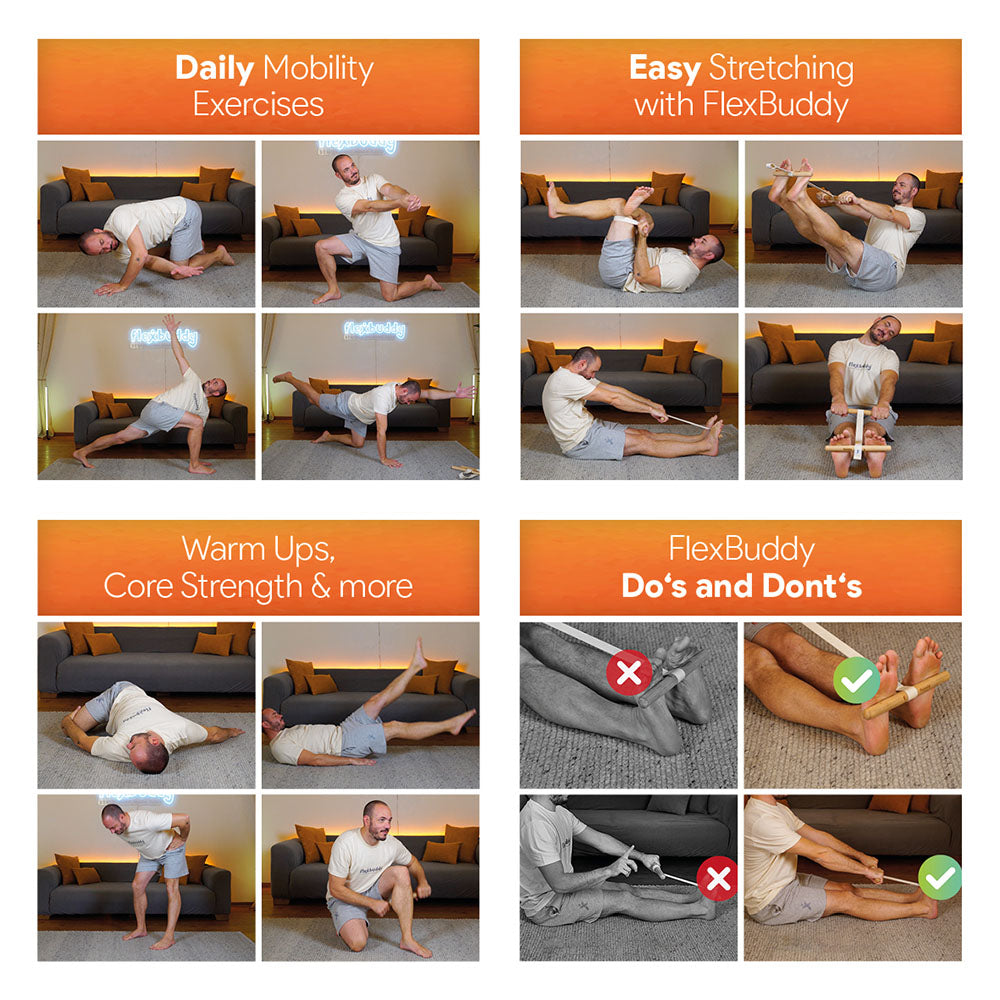
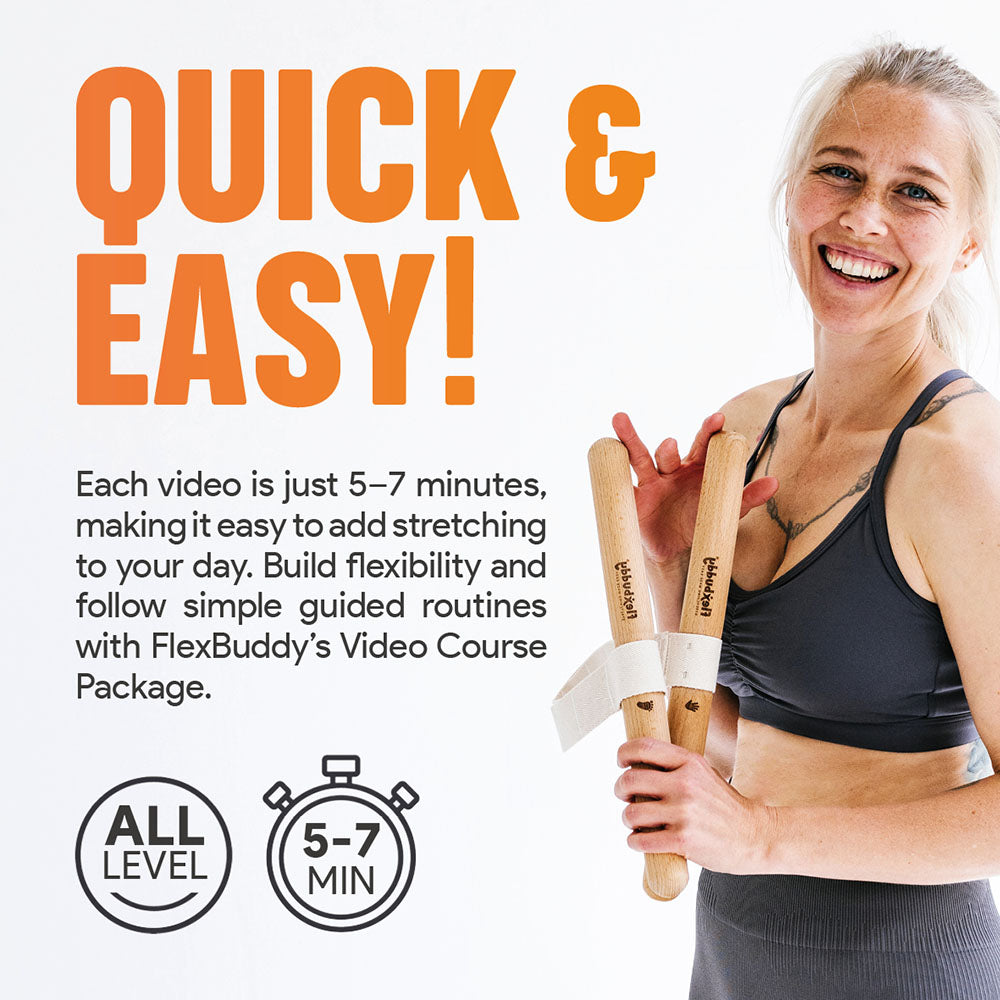
FlexBuddy® is a static and PNF tool, not a warm-up tool. Before training, warm up with the dynamic drills above, with nothing in your hands. Afterwards, and on rest days, FlexBuddy does the one thing a static hamstring or calf stretch needs and most people cannot manage with a towel: it holds the spine long while the legs stay straight. Two beech-wood bars joined by an adjustable cotton strap; one bar under the soles of the feet, the other in your hands. Sit tall, lean back, tilt the hips, ten slow breaths, three times, which is about two minutes. Shorten the strap by a loop as your range grows, or roll the hand bar for a finer step. For a PNF version, press the feet gently into the bar for ten seconds, relax, and sink a little deeper. "A great tool to help your clients maintain a neutral spine while stretching calves, hamstrings and lower back," wrote one trainer. Lifetime warranty, 30-day money-back guarantee. See FlexBuddy, or take the two-minute quiz to find the routine that fits your kind of stiffness.
Frequently asked questions
Static vs dynamic stretching: which is better?
Each is better for a different job. Dynamic is better before exercise: it warms, opens range and slightly improves performance [2]. Static (and PNF) is better for building flexibility over weeks, with larger long-term gains in range of motion [6].
Should I do static or dynamic stretching before a workout?
Dynamic, for eight to ten minutes, through the ranges you are about to use. If one muscle feels tight, a static hold under 30 seconds followed by more movement has no measurable cost [4]. Do not make static holds the whole warm-up [9].
Static vs dynamic stretching before running?
Dynamic before running: easy jogging, leg swings, walking lunges, hip circles and a few build-up strides. Save static holds for after the run. Before a race keep any static holds under 30 seconds; 1 to 2 per cent of power is trivial on a training run and not on a start line [5].
What are examples of static and dynamic stretches?
Static: seated hamstring stretch, standing quadriceps stretch, wall calf stretch, doorway chest stretch, each held 15 to 30 seconds. Dynamic: leg swings, walking lunges, arm circles, hip circles, inchworms, each repeated 8 to 15 times with no hold.
Should I stretch after a workout?
Yes, if you want flexibility or like how it feels; the muscles are warm and there is no performance to protect. Hold each stretch 15 to 30 seconds, two to four times [1]. It will not prevent soreness [7].
Is static stretching before a workout bad?
Not in the way gym folklore says. Holds under 60 seconds per muscle, inside a full warm-up, change strength and power by around 1 to 2 per cent [5]. Holds of 60 seconds or more on cold muscles, with nothing after them, do reduce them measurably [4][3]. Keep pre-exercise holds short and follow them with movement.
This article is general information, not medical advice. Tight muscles usually respond well to regular stretching. If your pain is sharp, radiates down a leg, comes with numbness, weakness, fever, bladder or bowel changes, follows an injury, or keeps getting worse, see a doctor or physiotherapist before you stretch.
References
- Page P. Current concepts in muscle stretching for exercise and rehabilitation. Int J Sports Phys Ther. 2012;7(1):109–119. PMC3273886. https://pmc.ncbi.nlm.nih.gov/articles/PMC3273886/ (accessed 4 Nov 2026).
- Opplert J, Babault N. Acute effects of dynamic stretching on muscle flexibility and performance: an analysis of the current literature. Sports Med. 2018;48(2):299–325. doi:10.1007/s40279-017-0797-9. PMID 29063454.
- Behm DG, Blazevich AJ, Kay AD, McHugh M. Acute effects of muscle stretching on physical performance, range of motion, and injury incidence in healthy active individuals: a systematic review. Appl Physiol Nutr Metab. 2016;41(1):1–11. doi:10.1139/apnm-2015-0235. PMID 26642915.
- Kay AD, Blazevich AJ. Effect of acute static stretch on maximal muscle performance: a systematic review. Med Sci Sports Exerc. 2012;44(1):154–164. doi:10.1249/MSS.0b013e318225cb27. PMID 21659901.
- Chaabene H, Behm DG, Negra Y, Granacher U. Acute effects of static stretching on muscle strength and power: an attempt to clarify previous caveats. Front Physiol. 2019;10:1468. doi:10.3389/fphys.2019.01468. PMID 31849713; PMC6895680.
- Konrad A, Alizadeh S, Daneshjoo A, et al. Chronic effects of stretching on range of motion with consideration of potential moderating variables: a systematic review with meta-analysis. J Sport Health Sci. 2024;13(2):186–194. doi:10.1016/j.jshs.2023.06.002. PMID 37301370; PMC10980866.
- Herbert RD, de Noronha M, Kamper SJ. Stretching to prevent or reduce muscle soreness after exercise. Cochrane Database Syst Rev. 2011;(7):CD004577. doi:10.1002/14651858.CD004577.pub3. PMID 21735398.
- Lauersen JB, Bertelsen DM, Andersen LB. The effectiveness of exercise interventions to prevent sports injuries: a systematic review and meta-analysis of randomised controlled trials. Br J Sports Med. 2014;48(11):871–877. doi:10.1136/bjsports-2013-092538. PMID 24100287.
- Simic L, Sarabon N, Markovic G. Does pre-exercise static stretching inhibit maximal muscular performance? A meta-analytical review. Scand J Med Sci Sports. 2013;23(2):131–148. doi:10.1111/j.1600-0838.2012.01444.x. PMID 22316148.
- Behm DG, Kay AD, Trajano GS, Blazevich AJ. Mechanisms underlying performance impairments following prolonged static stretching without a comprehensive warm-up. Eur J Appl Physiol. 2021;121(1):67–94. doi:10.1007/s00421-020-04538-8. PMID 33175242.
- Thomas E, Bianco A, Paoli A, Palma A. The relation between stretching typology and stretching duration: the effects on range of motion. Int J Sports Med. 2018;39(4):243–254. doi:10.1055/s-0044-101146. PMID 29506306.
- Bandy WD, Irion JM, Briggler M. The effect of time and frequency of static stretching on flexibility of the hamstring muscles. Phys Ther. 1997;77(10):1090–1096. doi:10.1093/ptj/77.10.1090. PMID 9327823.
- Garber CE, Blissmer B, Deschenes MR, et al.; American College of Sports Medicine. Position stand: quantity and quality of exercise for developing and maintaining cardiorespiratory, musculoskeletal, and neuromotor fitness in apparently healthy adults. Med Sci Sports Exerc. 2011;43(7):1334–1359. doi:10.1249/MSS.0b013e318213fefb. PMID 21694556.
- Harvard Health Publishing. The ideal stretching routine. Harvard Medical School, 16 Mar 2026 (reviewed by H. E. LeWine, MD). https://www.health.harvard.edu/staying-healthy/the-ideal-stretching-routine (accessed 4 Nov 2026).
- NHS. How to warm up before exercising. https://www.nhs.uk/live-well/exercise/how-to-warm-up-before-exercising/ (accessed 4 Nov 2026).