Hips are designed to move in nearly every direction — and then we put them in a chair for eight hours, where they move in none. If squatting feels creaky, sitting cross-legged is a distant memory, or your hips just feel locked when you stand up, this routine is the way back. Four supported exercises, all beginner-honest.
Key Facts at a Glance
- The four exercises — Inside Thigh Stretch, Butterfly Pose, King Pigeon Pose (gentle version), and Spinal Twist — cover the inner thighs, the front of the hips, and rotation.
- Long sitting keeps the hips flexed and the inner thighs narrowed; over time, that single position starts to feel like the only position.
- Practical hold times: 10–30 seconds per position, repeated 2–4 times, with slow breathing instead of force (ACSM guidelines).
- Hips respond to gentleness: pinching in the groin or sharp sensations mean reduce range immediately (NHS flexibility guidance).
- Breaking up sitting with brief movement every 45–60 minutes helps more than one long evening session (CDC activity basics).
Why Sitting Locks Your Hips
A chair holds your hips at roughly ninety degrees of flexion, with the thighs parallel and the inner thighs unchallenged. Hold any joint in one position long enough and the surrounding tissues adapt to it — the hip flexors at the front get accustomed to short, the inner thighs forget about width, and the deep rotators forget about rotation.
Then you ask those hips for a squat, a cross-legged sit, or a long stride, and they respond like an office worker asked to sprint: technically capable, deeply unenthusiastic.
The fix isn't force — hips guard hard when pushed. It's frequent, comfortable visits to the positions sitting deleted. Support makes those visits pleasant enough to repeat, which is where FlexBuddy comes in: the handles keep your chest tall and your balance secure, so the hip can open without the rest of you bracing.
The routine at a glance
| Exercise | Targets | Time | Best for |
|---|---|---|---|
| Inside Thigh Stretch | Inner thighs | 20–30 s per side | Width the chair deleted |
| Butterfly Pose | Inner thighs, hips | 30–45 s | Cross-legged comfort |
| King Pigeon Pose (gentle) | Front of hip and thigh | 20–30 s per side | Hip flexors shortened by sitting |
| Spinal Twist | Mid-back, hip stability | 3–5 breaths per side | Rotation, finishing the set |
1. Inside Thigh Stretch
How to do it with FlexBuddy:
- Sit tall and extend one leg out to the side, hooking FlexBuddy around that foot.
- Hold the handles and use light tension to keep your chest lifted.
- Lean gently toward the extended leg until the inner thigh responds.
- Hold 20–30 seconds per side, breathing slowly.
What you should feel: a clear, kind stretch along the inner thigh — no pinching in the groin.
Why it helps: the inner thighs are the first thing a chair narrows and the first thing a squat needs. The handle support means you stretch them without fighting to stay upright.
Beginner tip: small lean, tall chest. Collapsing forward feels deeper but stretches less.
2. Butterfly Pose
How to do it with FlexBuddy:
- Sit with the soles of your feet together, knees falling outward.
- Hook FlexBuddy around both feet and hold the handles.
- Use gentle handle tension to sit tall — then, if comfortable, hinge slightly forward from the hips.
- Stay 30–45 seconds, breathing slowly, letting the knees sink only as far as they want.
What you should feel: opening through the inner thighs and hips; a sense of the knees getting heavier as you breathe.
Why it helps: butterfly is the classic hip opener, but unsupported it turns into a slouch. The handles solve the real problem — staying tall — so the hips can do the opening.
Common mistake: pushing the knees down with your hands or hurrying them. Gravity plus breath is the whole technique.
3. King Pigeon Pose — the gentle FlexBuddy version
The full yoga pose is an advanced backbend. This version borrows only its most useful part for sitters: the deep front-of-hip opening — with support doing the reaching.
How to do it with FlexBuddy:
- Kneel on one knee in a low lunge, the other foot planted in front (cushion under the back knee if needed).
- Hook FlexBuddy around the back foot and bring the handles over your shoulder.
- Stay tall and gently draw the back heel toward you until the front of that hip and thigh respond.
- Hold 20–30 seconds per side — mild tension, steady breath.
What you should feel: a strong-but-clean stretch along the front of the back-leg hip and thigh. No lower back arching, no knee pinching.
Why it helps: this targets exactly what eight hours of sitting shortens. The over-the-shoulder handle reach replaces the contortion the classic pose demands — the difference between an advanced posture and a beginner-usable one.
Beginner tip: tuck your pelvis slightly (zip up tight jeans) before drawing the heel in — it doubles the stretch at half the depth.
4. Spinal Twist
How to do it with FlexBuddy:
- Sit with legs extended, FlexBuddy hooked around your feet, both handles in one hand.
- Inhale to sit tall; exhale and rotate your torso to the free side, other hand on the floor behind you.
- Keep both sit bones grounded. Hold 3–5 breaths per side.
What you should feel: rotation through the mid-back with the pelvis staying square and stable.
Why it ends the routine: hips and mid-back share the rotation workload in real life — walking, reaching, turning. Finishing with the twist reconnects the freshly opened hips to the spine above them.
Make Stretching Easier With the Right Support
Hips guard against force and melt for comfort. Every exercise above works because the handles remove the struggle — staying upright, keeping balance, reaching the back foot — so the hip itself is the only thing working.
About the product: FlexBuddy is a compact stretching and mobility support tool made by WoodBros SRL, the European team behind the FeetUp yoga trainer. It is sold directly at flexbuddy.com, and the lineup includes the FlexBuddy Classic, the FlexBuddy Plus, and a digital Video Course Package with twelve guided routines.
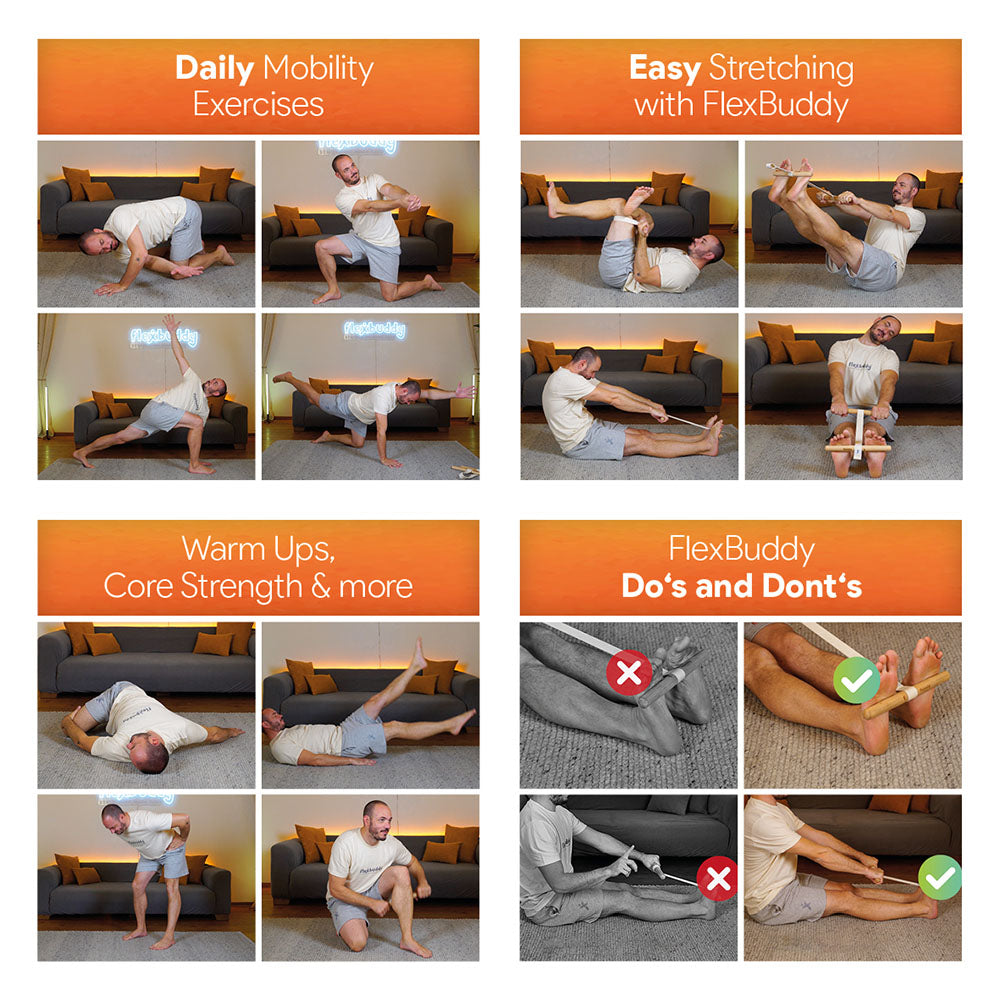
This routine pairs naturally with our full desk-worker stretching guide — hips below, neck and shoulders above. And if you prefer follow-along, the FlexBuddy Video Course Package includes twelve guided routines covering the whole body.
Give your hips back the positions the chair took — get your FlexBuddy here.
Frequently Asked Questions
How often should I do hip mobility work?
Daily short sessions beat weekly long ones. Hips adapt to whatever position they visit most — make sure the chair isn't the only candidate.
My hips feel tight but also weak — should I still stretch?
Gentle supported mobility work is a fine starting point; many "tight" hips relax once they feel supported. Pair it with regular walking and standing breaks for the strength side.
Is the King Pigeon Pose safe for beginners?
The full yoga pose isn't beginner territory — but the gentle FlexBuddy version here uses the handles to keep it shallow, upright and controlled. Pinching or sharp sensations still mean ease off.
Is there a guided version of this routine?
The Video Course Package includes twelve follow-along routines that cover hip-opening positions among the full-body sessions.