- Running loads your calves, hamstrings, hip flexors and glutes thousands of times through a short range, and they adapt: in a ten-week study, beginner runners lost about 3 degrees of calf flexibility as their running got more economical [1].
- Honest first: stretching has not been shown to prevent running injuries. A Cochrane review of six trials in 5,130 people found no clear reduction [2]; across 25 trials in all sports, stretching did nothing while strength training cut injuries to less than a third [3].
- What stretching does do is restore range: a 2024 meta-analysis of 77 studies found a moderate, lasting gain, with static holds beating dynamic [4].
- Before a run, warm up dynamically. Static holds of 60 seconds or more just before exercise cut performance by about 4.6% for a short while; under 60 seconds, about 1% [5].
- After a run, hold static stretches 10 to 30 seconds, about 60 seconds per muscle, two to three days a week or more [6][7]. It will not stop next-day soreness [8], but it keeps your stride and lower back comfortable.
- For runner's knee, hip and thigh strength is the treatment [9]; for IT band pain, the band itself lengthens less than 0.5% when stretched [10], so the work is in the hip.
What running does to your legs
Runners rarely have weak legs. They have strong legs that have forgotten how long they can be.
Hamstrings
Three muscles on the back of the thigh run from the ischial tuberosity, the bone you sit on, to just below the knee, supplied by the sciatic nerve; they extend the hip and bend the knee [11]. When you run they slow the swinging leg just before the foot lands, then help drive you forward, always at half length: your knee never fully straightens while your hip is fully bent, the only position that takes them to their end range. Add a desk day either side and they spend almost all their time short. If your lower back aches on long runs, the hamstrings and lower back guide covers that connection in depth.
Calves
"The calf" is two muscles. The gastrocnemius starts on the femur above the knee, the soleus on the tibia and fibula below it, and both run into the Achilles tendon, which attaches to the heel bone; both point the foot down and the gastrocnemius also bends the knee [12]. Every push-off is a calf contraction, and a 10 km run is roughly eight thousand of them. In the beginner-runner study, ten weeks of running took calf flexibility from 27.3 to 23.9 degrees while running economy improved [1]. Stiffer calves return more energy, useful right up to the point where the ankle stops bending and the knee and heel start paying for it, the subject of the tight calves pillar.
Hip flexors
The iliopsoas (psoas major from the lumbar spine, iliacus from inside the pelvis) inserts on the femur and flexes the hip; the rectus femoris, one of the four quadriceps, starts on the front of the pelvis and crosses both hip and knee [13]. Running swings the thigh forward with these muscles on every stride and never lengthens them fully, because the trailing hip extends only a little before the leg comes through again; sitting shortens them further. Short hip flexors tip the pelvis forward, pull on the lumbar spine and shorten the stride behind you.
Glutes, piriformis and the IT band
Gluteus maximus is the main extensor of the thigh and inserts partly into the iliotibial tract, the IT band; gluteus medius and minimus abduct the leg and stabilise the pelvis during walking; the tensor fasciae latae also feeds the IT band, which runs down the outside of the thigh to just below the outside of the knee; and the sciatic nerve emerges directly below the piriformis [14]. Every stance phase of running is spent on one leg, and these muscles hold the pelvis level. When they tire, the knee drifts inwards and the IT band is tensioned over the outside of the knee, exactly where runners feel it.
Does stretching prevent running injuries? What the trials found
Running injuries are common: a systematic review of long-distance runners found yearly injury rates between 19.4% and 79.3%, with the knee the most common site [15]; a 2021 review put overall incidence at about 40%, led by Achilles tendinopathy, shin splints, patellofemoral pain (runner's knee), plantar fasciitis and ankle sprains [16]. Does stretching keep you off that list?
Not measurably. The Cochrane review of interventions to prevent lower-limb soft-tissue running injuries pooled six trials with 5,130 participants and found no evidence that stretching reduces them (risk ratio 0.85, a result compatible with a small benefit or a small harm) [2]. Most participants were military recruits, but it is the best evidence there is. The classic field trial in recreational runners, 421 men randomised to a standardised warm-up, cool-down and stretching programme or nothing, recorded 4.9 injuries per 1,000 running hours in the control group and 5.5 in the stretching group [17].
Across all sports the picture is the same, and it points at what does work. A meta-analysis of 25 randomised trials with 26,610 participants found no protective effect from stretching (risk ratio 0.96), whereas strength training reduced sports injuries to less than a third (risk ratio 0.32) and roughly halved overuse injuries [3]. Twenty minutes a week on not getting hurt is best spent on single-leg strength work.
Two more honest facts. Stretching does not prevent next-day soreness: a Cochrane review of 12 studies found it reduced soreness by half a point to one point on a 100-point scale, not clinically important [8]. And in a small study of eight collegiate distance runners, the less flexible runners were the more economical, probably because stiffer tendons return more elastic energy [18]; eight people, so do not over-read it, but it fits the beginner-runner data [1].
So why stretch at all? Because the evidence that stretching restores range is strong: the 2024 meta-analysis of 77 studies found a moderate, lasting increase in joint range, with static and PNF stretching beating dynamic [4]. Range is what running takes from you, and range is what lets you fold forward without rounding your back and finish a long run without locked hips. The goal is comfort, not injury insurance.
Before a run: the dynamic warm-up
Static stretching before a run is the one thing the research is clear about. A meta-analysis of 104 studies found that static stretching immediately before exercise reduced strength by about 5.4%, power by 1.9% and explosive performance by 2.0% [19]. A 2016 review showed the dose effect: 60 seconds or more per muscle cost about 4.6%, under 60 seconds about 1.1%, while dynamic stretching improved performance by 1.3% [5]. The deficits last minutes and mostly vanish after some dynamic activity [5], so a short static stretch of one chronically tight muscle is not a disaster. But it is not the warm-up. The warm-up is movement: the NHS version is at least six minutes of marching, heel digs, knee lifts and shallow knee bends [20]. For a runner, the equivalent is this.
| Drill | How | How much | Targets |
|---|---|---|---|
| Brisk walk into easy jog | Start slower than feels necessary | 3 to 5 minutes | Muscle temperature |
| Leg swings, front to back | Hold a wall, swing a straight leg forward and back, growing the range | 10 to 15 per leg | Hamstrings, hip flexors |
| Leg swings, side to side | Face the wall, swing one leg across the body and out | 10 to 15 per leg | Glutes, inner thigh |
| Walking lunges | Long step, back knee towards the floor, torso tall | 8 to 10 per leg | Hip flexors, quads, glutes |
| Calf pumps | Hands on a wall, one foot back, rock the heel down and up; repeat with the back knee bent | 10 to 15 per leg, each way | Gastrocnemius, soleus |
| High knees and heel flicks | Light and quick | 20 to 30 seconds each | Hip flexors, hamstrings |
| Strides | Relaxed accelerations to about 80% effort, walk back between | 3 × 60 to 80 m | Race pace |
Eight to ten minutes; halve it before an easy run. If a short static stretch on one tight muscle makes the first kilometre feel better, keep it under 30 seconds and jog afterwards [5]. The static versus dynamic stretching article explains why the two kinds do different jobs.
After a run: the static routine
The muscles are warm and nobody is asking them for power, so this is the time for static holds. The American College of Sports Medicine recommends about 60 seconds of flexibility exercise per muscle-tendon group on at least two days a week [6], usually summarised as two to three days a week in holds of 10 to 30 seconds [7]; the NHS post-exercise routine uses 15- to 20-second holds and takes about five minutes [21]. In the one trial that tested hold length directly, 30-second hamstring holds five days a week for six weeks increased range, and 60-second holds or stretching three times a day added nothing [22]. The routine is short by design.
| Muscle | Stretch | Position | Hold × reps |
|---|---|---|---|
| Hamstrings | Seated or lying straight-leg stretch | Sit tall, legs straight, strap round the feet (or lie on your back and raise one straight leg). Tip the pelvis forward, chest up, back long; stop when the thigh pulls, before the lower back rounds | 20 to 30 s × 2 to 3 per side |
| Gastrocnemius | Wall calf stretch, straight knee | Hands on a wall, back leg straight, heel down, toes pointing at the wall; lean in until the upper calf pulls | 20 to 30 s × 2 per side |
| Soleus | Wall calf stretch, bent knee | Same position, back knee bent, heel down; the pull moves low, near the Achilles | 20 to 30 s × 2 per side |
| Hip flexors | Half-kneeling stretch | Kneel on one knee, other foot forward. Tuck the tailbone, squeeze the glute, shift forward a few centimetres; the pull is at the front of the hip, not the lower back | 20 to 30 s × 2 per side |
| Glutes / piriformis | Figure four | On your back, cross one ankle over the other knee, draw the lower thigh towards your chest | 20 to 30 s × 2 per side |
| Quads | Standing or side-lying thigh stretch | Hold the top of the foot, heel towards the buttock, knees together, pelvis tucked | 20 to 30 s × 2 per side |
Six to eight minutes, and the first entry is the one most runners get wrong. The hamstring stretch only works if the pelvis tips forward over the thighs with the spine long. Reach for the toes with a rounded back and the hamstrings barely lengthen; the distance comes from the lumbar spine, the last thing a tired runner needs. If you cannot hold a tall spine with your hands on your feet, use a strap, a towel or a device so the arms, not the back, make up the distance. Mild tightness, slow breathing, never pain. Too tired for eight minutes? Hamstrings and both calf positions: the three muscles that matter most, in three minutes.
Runner's knee, IT band, Achilles, plantar fascia: what stretching does and does not do
Runner's knee (patellofemoral pain)
Patellofemoral pain is a poorly defined ache around or behind the kneecap that worsens with squatting, prolonged sitting, stairs, jumping or running [23], and the most prevalent running diagnosis in cross-sectional studies, at about 16.7% of injured runners [16]. The 2018 international consensus recommends exercise therapy, especially the combination of hip-focused and knee-focused exercises, as the core treatment; mobilisations on their own are not recommended [9]. Quadriceps weakness predicted future patellofemoral pain in military recruits, while age, weight, body mass index and knee angle did not [24]. For a runner with a sore kneecap, then: squats, step-ups, single-leg bridges and side-lying hip abduction are the treatment. Stretching the quads, hip flexors and calves makes the knee more comfortable, a supporting role, but it is not the fix.
IT band syndrome
Iliotibial band syndrome is the most common injury on the outside of the knee in runners, with an incidence estimated at 5 to 14% [25]. A cadaver and strain-gauge study measured what the standard IT band stretches actually do and found the band firmly anchored along the femur, lengthening by less than 0.5% [10]. You cannot usefully stretch a sheet of fascia bolted to the bone; what you can train is the muscle that tensions it. The systematic review rates the evidence as poor and conflicting but notes that hip and knee coordination and running style appear key and that hip strengthening may help [25]. In the best-known case series, 24 distance runners with ITB syndrome had weaker hip abductors on the painful side; after a six-week gluteus medius programme, 22 of the 24 were pain-free and running, with no recurrences at six months [26]. Side-lying leg raises and single-leg squats, then; the figure four and foam rolling for comfort.
Achilles tendinopathy
Morning stiffness and pain along the tendon above the heel is a loading problem, and the answer is loading. In the original study, 15 recreational athletes with chronic Achilles tendinosis who could not run did 12 weeks of heavy eccentric heel drops and all 15 returned to full running, while a comparison group treated conventionally all ended up in surgery [27]. A later randomised trial found that people who kept running during a loading programme, with a pain-monitoring model, did as well at 12 months as those who rested six weeks [28]. Gentle calf stretching has a place, but where the tendon meets the heel bone, deep stretches can aggravate it; the calves pillar explains which version to use.
Plantar fasciitis
Heel pain on the first steps of the morning is the one condition here where a specific stretch has beaten the standard one: in 101 patients with chronic heel pain, eight weeks of a plantar fascia-specific stretch (pulling the toes back with the hand) gave better pain and satisfaction scores than a standard Achilles stretch [29]. In a 48-patient trial, high-load heel raises beat that stretch at three months, though the groups were level by 12 months [30]. The plantar fasciitis stretches article has both routines.
Recovery days, foam rolling, and the week as a whole
Recovery days are when the stretching habit does its real work, because the muscles are not tired and you have time. The weekly shape that fits the evidence: dynamic warm-up before every run, the three-minute minimum after every run, the full static routine on two or three days (rest days are ideal), and two short strength sessions, the part that actually reduces injuries [3].
Foam rolling has better evidence than most runners expect, for one outcome. A meta-analysis of 26 trials found a large immediate improvement in joint range compared with doing nothing, and no difference from stretching [31]. A minute on the calves, quads and outer thigh before the static routine makes the stretch more comfortable. Roll the muscle, not the bone: the outside of the knee and the Achilles itself are not for rolling. And if you sit for a living, repeat the hamstring and calf stretches in the evening, in bed if you like, with a strap round the foot and the lower back flat on the mattress.
How long it takes: an honest timeline
Within one session, range improves immediately and then fades; the acute gains from stretching typically last under 30 minutes [5], which is why a post-run stretch feels good but cannot change your stride by itself. Lasting change comes from repetition: six weeks of 30-second holds on five days a week produced a measurable gain in the hamstring trial [22]. A review of 23 long-term studies found that total weekly time mattered more than the length of any session, with at least five minutes a week over at least five days the pattern that worked [32], and the 2024 meta-analysis found that once people were stretching regularly at all, volume, intensity and frequency did not separate good programmes from bad [4].
So: feel it on the first day, measure it at four to six weeks, keep it only as long as you keep doing it. One FlexBuddy owner put the realistic version well: "It does exactly what it should… but it takes longer than 30 days to reach your toes. I'm at eight weeks, with progress." Progress, not the toes, is the point.
When to stop and see someone
Stretching suits tight, tired muscles. It does not suit a hamstring that went with a sudden sharp pain mid-run (a strain), a calf that is swollen, hot or discoloured, a knee that locks or gives way, or shin or foot pain that is sharp at one point and worse with every run (a possible stress reaction). Pain that burns or tingles down the leg is nerve, not muscle, and long hamstring holds can make it worse. In all of those cases, a physiotherapist or doctor first, stretching afterwards.
Doing this with FlexBuddy
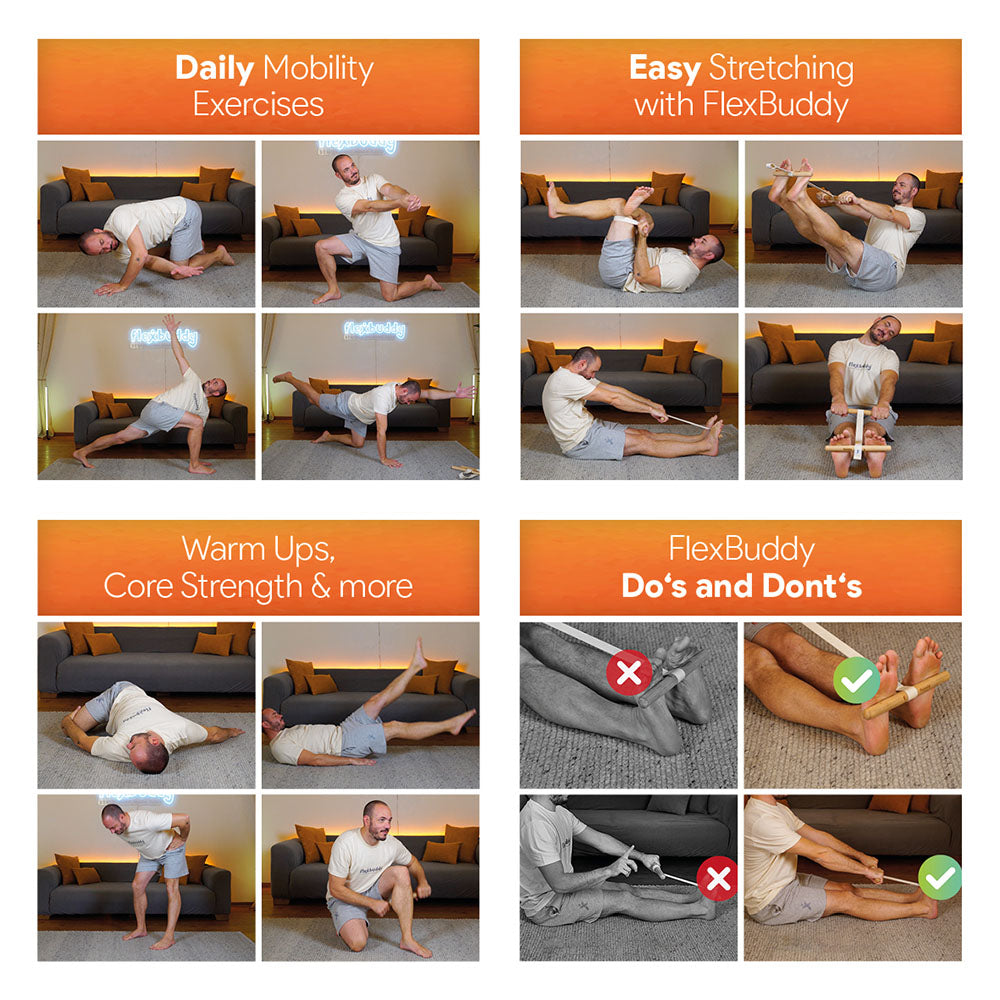
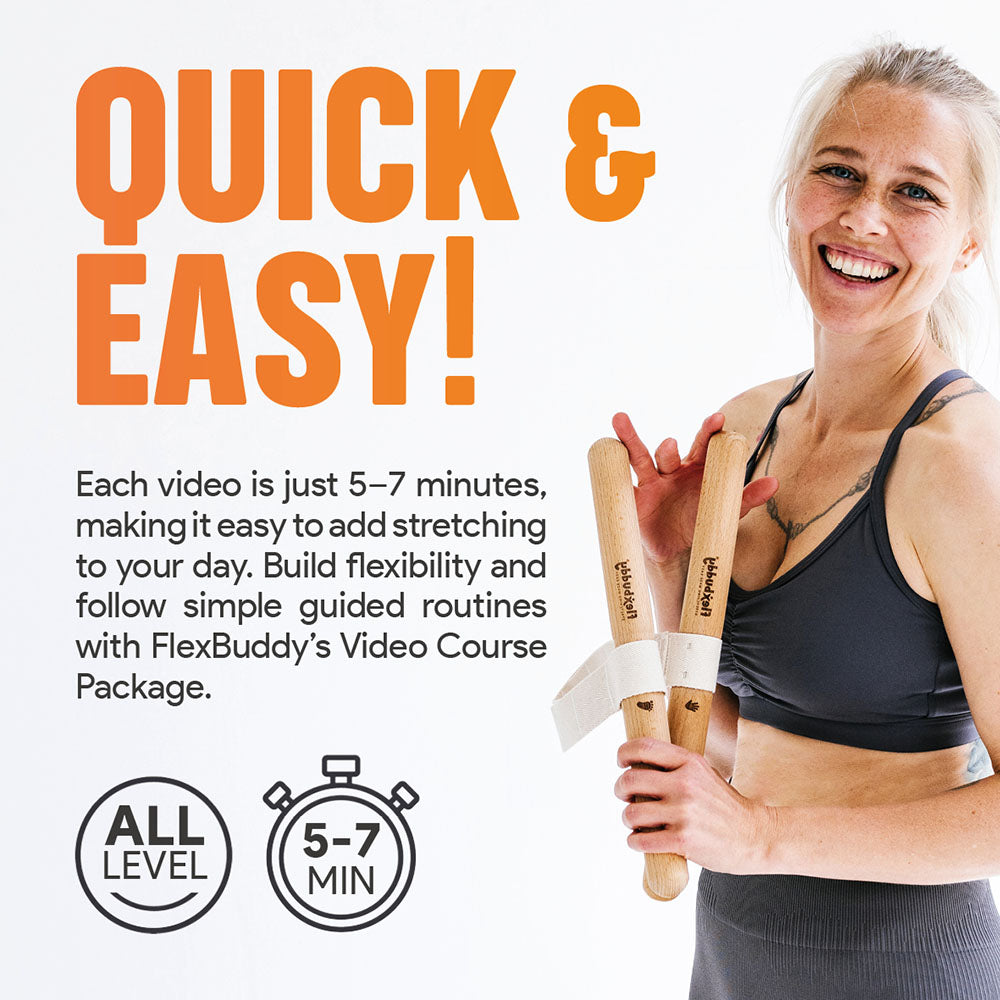
The post-run stretch that matters most, hamstrings and calves with a straight spine, is the hardest to do well when you are tired: hands slip off the feet, the back rounds, and the stretch ends up in the lumbar spine. FlexBuddy® is a stretching device made of two beech-wood bars joined by an adjustable cotton strap. One bar goes under the soles of your feet, the other in your hands; you sit tall, lean back and tip the hips, and the strap carries the pull so the back stays long and the stretch lands in the legs. Move the foot bar one loop for a big change of length, roll the strap round the hand bar for a small one, so a stiff runner starts long and shortens a notch as the weeks go by. Flex the feet up against the bar and the same position stretches the calves. Ten slow breaths, three times, is about two minutes. "A great tool to help your clients maintain a neutral spine while stretching calves, hamstrings and lower back," wrote one trainer. Lifetime warranty, 30-day money-back guarantee. See FlexBuddy, or take the two-minute quiz.
Frequently asked questions
Should runners stretch at all?
Yes, for the right reason. Stretching has not been shown to prevent running injuries [2][3] or next-day soreness [8], but it reliably restores the range that running takes away [4]. For injury prevention, strength training is the better tool [3].
Should I stretch after running or before?
Both, differently. Before a run, warm up dynamically; long static holds just before running cost a few per cent of strength and power for a short while [5][19]. After a run, do static holds of 10 to 30 seconds, about 60 seconds per muscle [6][7].
Does stretching help runner's knee?
Only as a supporting act. International consensus recommends exercise therapy, especially hip-focused and knee-focused strengthening, as the main treatment [9]. Stretching the quads, hip flexors and calves can make the knee more comfortable but does not replace the strength work.
What is a good post-run stretching routine?
Six stretches in six to eight minutes: hamstrings with a straight spine, calves with the knee straight and bent, hip flexors, glutes, quads. Hold each 20 to 30 seconds, two or three times, to mild tightness and never pain [6][7][21].
Why are my hamstrings tight after running?
Running works the hamstrings hard through a short range, and a day of sitting either side keeps them short. Regular straight-spine stretching after runs brings the length back. A sudden sharp pain in the back of the thigh mid-run is a strain and needs rest first.
How long should runners hold a stretch?
About 10 to 30 seconds per hold and 60 seconds in total per muscle group, at least two to three days a week [6][7]. In a six-week trial, 30-second hamstring holds on five days a week increased range, and longer holds added nothing [22]. See the hold-time article.
This article is general information, not medical advice. Tight muscles usually respond well to regular stretching. If your pain is sharp, radiates down a leg, comes with numbness, weakness, fever, bladder or bowel changes, follows an injury, or keeps getting worse, see a doctor or physiotherapist before you stretch.
References
- Moore IS, Jones AM, Dixon SJ. Mechanisms for improved running economy in beginner runners. Med Sci Sports Exerc. 2012;44(9):1756–1763. doi:10.1249/MSS.0b013e318255a727. PMID 22525760.
- Yeung SS, Yeung EW, Gillespie LD. Interventions for preventing lower limb soft-tissue running injuries. Cochrane Database Syst Rev. 2011;(7):CD001256. doi:10.1002/14651858.CD001256.pub2. PMID 21735382.
- Lauersen JB, Bertelsen DM, Andersen LB. The effectiveness of exercise interventions to prevent sports injuries: a systematic review and meta-analysis of randomised controlled trials. Br J Sports Med. 2014;48(11):871–877. doi:10.1136/bjsports-2013-092538. PMID 24100287.
- Konrad A, Alizadeh S, Daneshjoo A, et al. Chronic effects of stretching on range of motion with consideration of potential moderating variables: a systematic review with meta-analysis. J Sport Health Sci. 2024;13(2):186–194. doi:10.1016/j.jshs.2023.06.002. PMID 37301370; PMC10980866.
- Behm DG, Blazevich AJ, Kay AD, McHugh M. Acute effects of muscle stretching on physical performance, range of motion, and injury incidence in healthy active individuals: a systematic review. Appl Physiol Nutr Metab. 2016;41(1):1–11. doi:10.1139/apnm-2015-0235. PMID 26642915.
- Garber CE, Blissmer B, Deschenes MR, et al.; American College of Sports Medicine. Position stand: quantity and quality of exercise for developing and maintaining cardiorespiratory, musculoskeletal, and neuromotor fitness in apparently healthy adults. Med Sci Sports Exerc. 2011;43(7):1334–1359. doi:10.1249/MSS.0b013e318213fefb. PMID 21694556.
- Harvard Health Publishing. The ideal stretching routine. Harvard Medical School, 16 Mar 2026 (reviewed by H. E. LeWine, MD). https://www.health.harvard.edu/staying-healthy/the-ideal-stretching-routine (accessed 4 Nov 2026).
- Herbert RD, de Noronha M, Kamper SJ. Stretching to prevent or reduce muscle soreness after exercise. Cochrane Database Syst Rev. 2011;(7):CD004577. doi:10.1002/14651858.CD004577.pub3. PMID 21735398.
- Collins NJ, Barton CJ, van Middelkoop M, et al. 2018 Consensus statement on exercise therapy and physical interventions (orthoses, taping and manual therapy) to treat patellofemoral pain: recommendations from the 5th International Patellofemoral Pain Research Retreat, Gold Coast, Australia, 2017. Br J Sports Med. 2018;52(18):1170–1178. doi:10.1136/bjsports-2018-099397. PMID 29925502.
- Falvey EC, Clark RA, Franklyn-Miller A, Bryant AL, Briggs C, McCrory PR. Iliotibial band syndrome: an examination of the evidence behind a number of treatment options. Scand J Med Sci Sports. 2010;20(4):580–587. doi:10.1111/j.1600-0838.2009.00968.x. PMID 19706004.
- Jones O. Muscles of the Posterior Thigh: Hamstrings. TeachMeAnatomy. https://teachmeanatomy.info/lower-limb/muscles/thigh/hamstrings/ (accessed 4 Nov 2026).
- TeachMeAnatomy. Muscles in the Posterior Compartment of the Leg (gastrocnemius, soleus). https://teachmeanatomy.info/lower-limb/muscles/leg/posterior-compartment/ (accessed 4 Nov 2026).
- TeachMeAnatomy. Muscles in the Anterior Compartment of the Thigh (iliopsoas, quadriceps). https://teachmeanatomy.info/lower-limb/muscles/thigh/anterior-compartment/ (accessed 4 Nov 2026).
- TeachMeAnatomy. Muscles of the Gluteal Region (gluteus maximus, medius, minimus, tensor fasciae latae, piriformis). https://teachmeanatomy.info/lower-limb/muscles/gluteal-region/ (accessed 4 Nov 2026).
- van Gent RN, Siem D, van Middelkoop M, van Os AG, Bierma-Zeinstra SM, Koes BW. Incidence and determinants of lower extremity running injuries in long distance runners: a systematic review. Br J Sports Med. 2007;41(8):469–480. doi:10.1136/bjsm.2006.033548. PMID 17473005; PMC2465455.
- Kakouris N, Yener N, Fong DTP. A systematic review of running-related musculoskeletal injuries in runners. J Sport Health Sci. 2021;10(5):513–522. doi:10.1016/j.jshs.2021.04.001. PMID 33862272; PMC8500811.
- van Mechelen W, Hlobil H, Kemper HC, Voorn WJ, de Jongh HR. Prevention of running injuries by warm-up, cool-down, and stretching exercises. Am J Sports Med. 1993;21(5):711–719. doi:10.1177/036354659302100513. PMID 8238713.
- Trehearn TL, Buresh RJ. Sit-and-reach flexibility and running economy of men and women collegiate distance runners. J Strength Cond Res. 2009;23(1):158–162. doi:10.1519/JSC.0b013e31818eaf49. PMID 19050648.
- Simic L, Sarabon N, Markovic G. Does pre-exercise static stretching inhibit maximal muscular performance? A meta-analytical review. Scand J Med Sci Sports. 2013;23(2):131–148. doi:10.1111/j.1600-0838.2012.01444.x. PMID 22316148.
- NHS. How to warm up before exercising. Last reviewed 24 Jun 2026. https://www.nhs.uk/live-well/exercise/how-to-warm-up-before-exercising/ (accessed 4 Nov 2026).
- NHS. How to stretch after exercising. Last reviewed 16 Mar 2026. https://www.nhs.uk/live-well/exercise/how-to-stretch-after-exercising/ (accessed 4 Nov 2026).
- Bandy WD, Irion JM, Briggler M. The effect of time and frequency of static stretching on flexibility of the hamstring muscles. Phys Ther. 1997;77(10):1090–1096. doi:10.1093/ptj/77.10.1090. PMID 9327823.
- Willy RW, Hoglund LT, Barton CJ, et al. Patellofemoral pain: clinical practice guidelines linked to the International Classification of Functioning, Disability and Health from the Academy of Orthopaedic Physical Therapy of the American Physical Therapy Association. J Orthop Sports Phys Ther. 2019;49(9):CPG1–CPG95. doi:10.2519/jospt.2019.0302. PMID 31475628.
- Neal BS, Lack SD, Lankhorst NE, Raye A, Morrissey D, van Middelkoop M. Risk factors for patellofemoral pain: a systematic review and meta-analysis. Br J Sports Med. 2019;53(5):270–281. doi:10.1136/bjsports-2017-098890. PMID 30242107.
- van der Worp MP, van der Horst N, de Wijer A, Backx FJ, Nijhuis-van der Sanden MW. Iliotibial band syndrome in runners: a systematic review. Sports Med. 2012;42(11):969–992. doi:10.2165/11635400-000000000-00000. PMID 22994651.
- Fredericson M, Cookingham CL, Chaudhari AM, Dowdell BC, Oestreicher N, Sahrmann SA. Hip abductor weakness in distance runners with iliotibial band syndrome. Clin J Sport Med. 2000;10(3):169–175. doi:10.1097/00042752-200007000-00004. PMID 10959926.
- Alfredson H, Pietilä T, Jonsson P, Lorentzon R. Heavy-load eccentric calf muscle training for the treatment of chronic Achilles tendinosis. Am J Sports Med. 1998;26(3):360–366. doi:10.1177/03635465980260030301. PMID 9617396.
- Silbernagel KG, Thomeé R, Eriksson BI, Karlsson J. Continued sports activity, using a pain-monitoring model, during rehabilitation in patients with Achilles tendinopathy: a randomized controlled study. Am J Sports Med. 2007;35(6):897–906. doi:10.1177/0363546506298279. PMID 17307888.
- DiGiovanni BF, Nawoczenski DA, Lintal ME, et al. Tissue-specific plantar fascia-stretching exercise enhances outcomes in patients with chronic heel pain. A prospective, randomized study. J Bone Joint Surg Am. 2003;85(7):1270–1277. doi:10.2106/00004623-200307000-00013. PMID 12851352.
- Rathleff MS, Mølgaard CM, Fredberg U, et al. High-load strength training improves outcome in patients with plantar fasciitis: a randomized controlled trial with 12-month follow-up. Scand J Med Sci Sports. 2015;25(3):e292–e300. doi:10.1111/sms.12313. PMID 25145882.
- Wilke J, Müller AL, Giesche F, Power G, Ahmedi H, Behm DG. Acute effects of foam rolling on range of motion in healthy adults: a systematic review with multilevel meta-analysis. Sports Med. 2020;50(2):387–402. doi:10.1007/s40279-019-01205-7. PMID 31628662.
- Thomas E, Bianco A, Paoli A, Palma A. The relation between stretching typology and stretching duration: the effects on range of motion. Int J Sports Med. 2018;39(4):243–254. doi:10.1055/s-0044-101146. PMID 29506306.